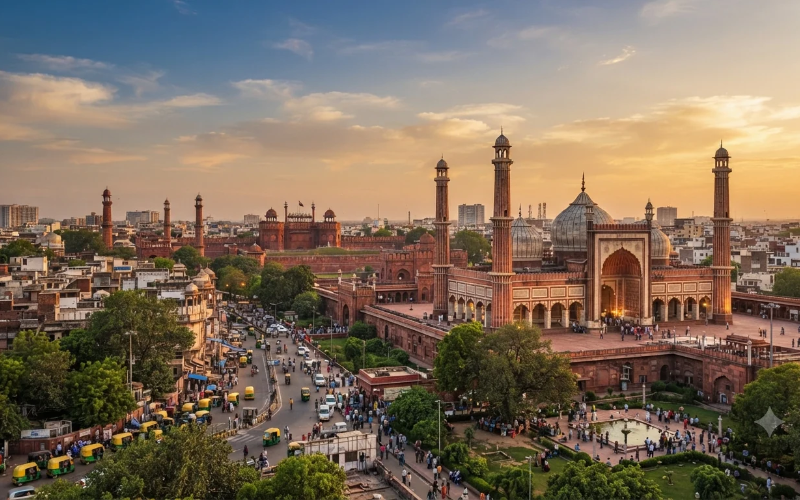
DELHI
Explore the Heritage, History, Spirituality and Culinary Traditions of Delhi
UNESCO HERITAGE
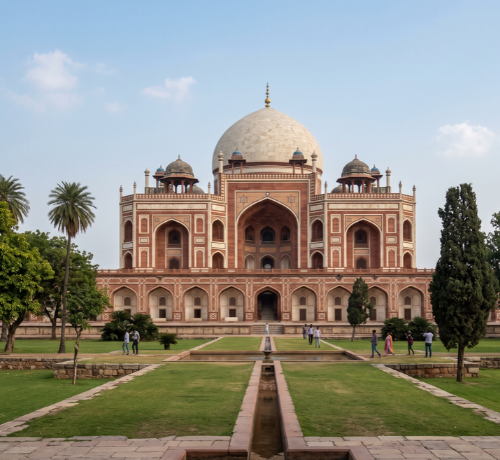
Humayun’s Tomb, New Delhi
Humayun’s Tomb is among the earliest grand dynastic mausoleums of the Mughal period, establishing an architectural tradition that reached its culmination nearly eighty years later in the Taj Mahal. Spread across 27.04 hectares, the complex includes Nila Gumbad, Isa Khan’s Tomb, Bu Halima’s Tomb, Afsarwala Tomb, Barber’s Tomb and Arab Serai.
Constructed during the 1560s under the patronage of Emperor Akbar, the mausoleum represents a collaboration between Persian and Indian craftsmen. It stands within a charbagh, a four-part garden inspired by the Quranic description of paradise, with water channels and interconnected pools.
The mausoleum rises from an elevated terraced platform and follows an irregular octagonal plan. It is crowned by a 42.5-metre-high marble-clad double dome, surrounded by pillared kiosks known as chhatris. Its red sandstone exterior is complemented by white and black marble inlay.
The spacious octagonal central chamber is surrounded by vaulted compartments connected through galleries and corridors. The monument is also known as the Dormitory of the Mughals because more than 150 members of the Mughal royal family are buried within its chambers.
The tomb occupies a significant archaeological landscape associated with the fourteenth-century Sufi saint Hazrat Nizamuddin Auliya. Centuries of tomb construction around the shrine have created one of India’s densest concentrations of medieval Islamic monuments.
Source: UNESCO World Heritage Centre
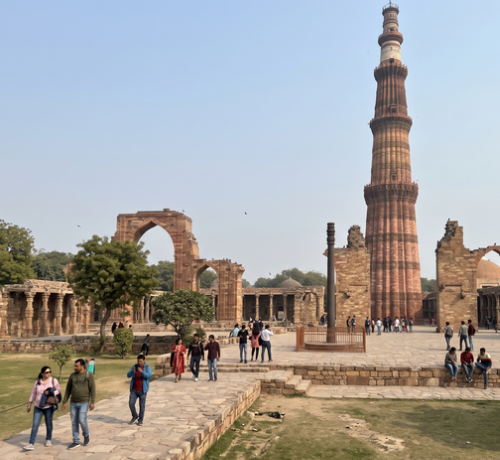
Qutab Minar and its Monuments, New Delhi
Rising to a height of 72.5 metres, Qutab Minar is the tallest masonry tower in India. Constructed during the twelfth century using red and buff sandstone, it is an outstanding example of medieval Indian architecture.
Qutb-ud-din Aibak, founder of the Delhi Sultanate, began construction in 1199 and completed the first storey. His successor, Shamsuddin Iltutmish, added three additional storeys. The tower was conceived as a victory tower and an elevated platform from which the mu’azzin could issue the call to prayer.
Its projecting balconies are supported by elaborately carved stone brackets arranged in honeycomb patterns. Inscriptions in Arabic and Nagari scripts provide important information about its construction and subsequent repairs under Firuz Shah Tughlaq and Sikandar Lodi.
The surrounding Qutub Complex includes the Quwwat-ul-Islam Mosque, Alai Darwaza, Alai Minar, Iron Pillar and the tombs of prominent historical figures, including Iltutmish and Alauddin Khalji.
Source: Incredible India
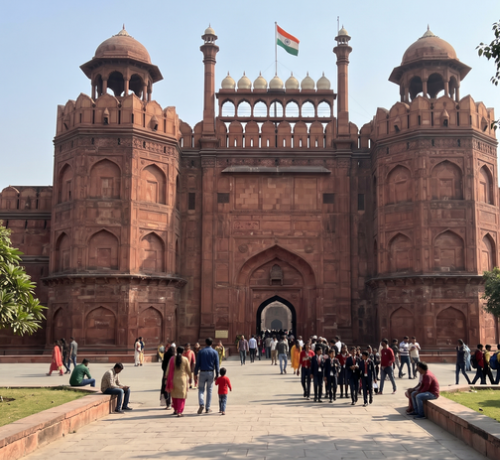
Red Fort Complex, Delhi
The Red Fort formed the centre of Shahjahanabad, the Mughal capital established by Emperor Shah Jahan in present-day Old Delhi. Construction began in 1639 when Shah Jahan decided to transfer his imperial court from Agra to Delhi. The fort subsequently served as the residence of successive Mughal emperors for nearly two centuries.
Spread across approximately 255 acres, the complex has an irregular octagonal plan and combines Islamic, Persian, Timurid and Hindu architectural influences. Its defensive walls extend approximately 2.4 kilometres and are constructed primarily of red sandstone.
The principal entrance is the Lahori Gate, beyond which lies Meena Bazaar, also known as Chhatta Chowk. Visitors then reach the Naubat Khana, Diwan-i-Am and the former residential quarters of the royal household.
Important structures include Mumtaz Mahal, Rang Mahal, Khas Mahal, Diwan-i-Khas, Hammam, Moti Masjid, Hira Mahal and Shah Burj. The Hayat Bakhsh Bagh, with its Zafar Mahal and Sawan and Bhadon pavilions, is another significant feature of the complex.
Source: Incredible India
MUSEUMS
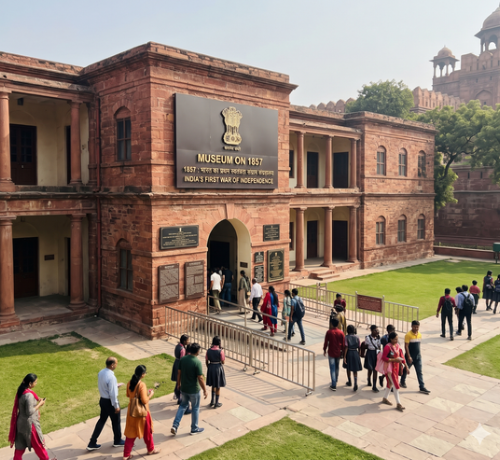
1857 – India’s First War of Independence Museum
Located within the Kranti Mandir complex at the Red Fort, this museum was inaugurated on 23 January 2019. It occupies Barrack 1, a British-era military barrack constructed following the uprising of 1857.
The museum traces the progression of the uprising and highlights the courage and sacrifices of those who participated in India’s First War of Independence. Its exhibits include archival documents, replicas and paintings depicting the events of 1857, along with artefacts associated with Bahadur Shah Zafar.
It forms part of a broader initiative to transform the colonial-era barracks of the Red Fort into a museum complex dedicated to India’s freedom struggle.
Sources: Prime Minister’s Office; Ministry of Culture; Incredible India; Delhi Tourism.
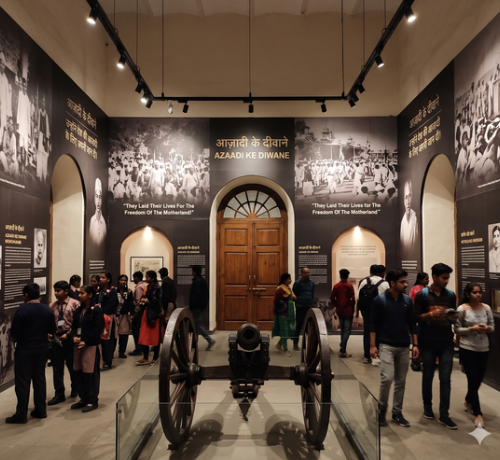
The Azaadi Ke Diwane Museum
The Azaadi Ke Diwane Museum at the Red Fort commemorates the lesser-known heroes who fought for India’s independence. It forms part of the Kranti Mandir series and aims to educate younger generations about the sacrifices made during the freedom movement.
Developed by the Archaeological Survey of India, the two-storeyed museum contains 22 thematic zones arranged chronologically from 1857 to 1947. Its displays include more than 150 exhibition panels, a digital tribute room, archival records, audiovisual presentations and installations recreating historical events.
An interactive touchscreen dictionary compiled by the ICHR and National Archives of India enables visitors to explore the lives of individuals who lost their lives in the struggle for independence.
Address: Lal Qila, Chandni Chowk, Delhi.
Source: Museums of India
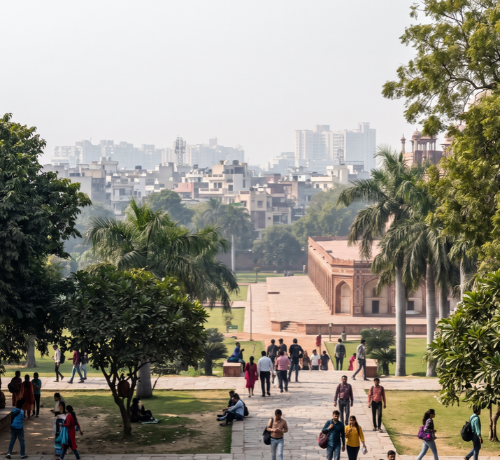
Netaji Subhas Chandra Bose and INA Museum
Located within the Kranti Mandir complex at the Red Fort, the museum is dedicated to Netaji Subhas Chandra Bose and the Indian National Army. Its foundation stone was laid on 21 October 2018, marking the 75th anniversary of the establishment of the Azad Hind Government. It was inaugurated on 23 January 2019.
Housed in a British-era barrack where INA soldiers were court-martialled, the museum documents Netaji’s life and the history of the Indian National Army.
Its collection includes a wooden chair, sword and cap associated with Netaji, along with INA uniforms, medals, badges, photographs, newspaper clippings, archival documents and multimedia presentations.
Sources: Prime Minister’s Office; IANS; Hindustan Times; The Week.
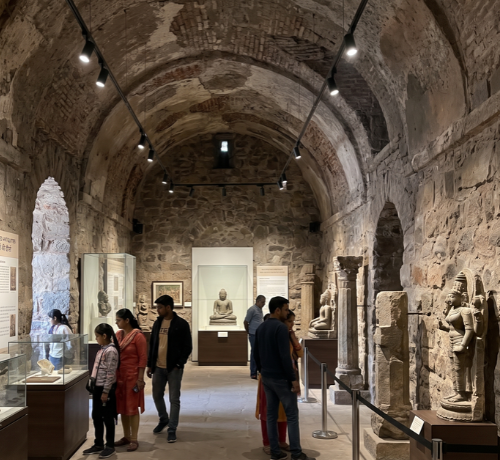
The Gallery of Confiscated and Retrieved Antiquities
Situated at Purana Qila, the Gallery of Confiscated and Retrieved Antiquities was inaugurated by the Ministry of Culture in 2019. Curated by the Archaeological Survey of India, it displays antiquities illegally smuggled out of India and subsequently repatriated, as well as objects confiscated by law enforcement agencies.
The gallery forms part of the ASI’s Central Antiquity Collection, established in the 1910s and housed at Purana Qila since 1974.
At inauguration, 198 artefacts spanning ancient to modern periods were displayed from a collection of more than 4,000 recovered and confiscated antiquities. The gallery highlights the importance of safeguarding India’s cultural heritage under the Antiquities and Art Treasures Act, 1972.
Sources: Press Information Bureau; Archaeological Survey of India; Ministry of Culture.
Archaeological Museum, Purana Qila
The Red Fort Archaeological Museum, housed in Mumtaz Mahal within the Red Fort, presents the artistic achievements and cultural history of the Mughal period through paintings, sculptures, artworks and historical artefacts.
Originally known as the Palace Museum, it comprises three galleries. These display miniature paintings, manuscripts, royal decrees, inscriptions, coins, bronze sculptures, textiles, seals and artefacts associated with the Indus Valley Civilisation.
A separate gallery focuses on the Indian Uprising of 1857 and preserves objects associated with Bahadur Shah Zafar, including his personal possessions, ghazals, inkpot, pen holder and perfume sprinkler.
Timings: 9:15 a.m. – 4:30 p.m. (Open all days).
Nearest Metro: Chandni Chowk, Yellow Line.
Source: Delhi Tourism
The Yaad-e-Jallian Museum, Delhi
The Yaad-e-Jallian Museum, located within the Kranti Mandir complex at the Red Fort, was inaugurated on 23 January 2019. It commemorates the Jallianwala Bagh massacre of 13 April 1919 and the sacrifices of Indian soldiers during the First World War.
The galleries present a chronological account of the massacre, the arrival of General Dyer in Amritsar and the subsequent investigations conducted by the Hunter Committee and an Indian inquiry.
A separate section recognises Indian soldiers who served during the First World War and features Sarojini Naidu’s poem The Gift of India. Photographs, paintings, archival documents and multimedia installations help visitors understand these significant episodes of colonial history.
Sources: Prime Minister’s Office; PTI; IANS; Outlook; The Week.
HISTORICAL MONUMENTS
Qutab Minar and Qutab Archaeological Complex
Qutab Minar, constructed of red and buff sandstone, rises to 72.5 metres and has a diameter of 14.32 metres at its base, tapering to approximately 2.75 metres at the top.
Its foundation was laid in 1199 CE by Qutb-ud-din Aibak, who completed the first storey. Shamsuddin Iltutmish added three more storeys. Inscriptions in Arabic and Nagari scripts record subsequent repairs under Firuz Shah Tughlaq, Sikandar Lodi and Major R. Smith in 1829.
The Quwwat-ul-Islam Mosque, constructed in 1198 CE, is the earliest surviving mosque built by the rulers of the Delhi Sultanate. Its courtyard contains the celebrated Iron Pillar, which bears a fourth-century Sanskrit inscription in Brahmi script.
Other important structures include the tomb of Iltutmish, Alai Darwaza and the unfinished Alai Minar, commissioned by Alauddin Khalji. Together, these structures illustrate the architectural developments of the Delhi Sultanate.
Source: Archaeological Survey of India
Humayun’s Tomb Complex, New Delhi
Humayun’s Tomb is among the earliest grand Mughal dynastic mausoleums. Constructed during the 1560s under Emperor Akbar, it brought together Persian and Indian architectural traditions.
The 27.04-hectare complex includes Nila Gumbad, Isa Khan’s Tomb, Bu Halima’s Tomb, Afsarwala Tomb, Barber’s Tomb and Arab Serai. Its charbagh garden is organised around four divisions, water channels and interconnected pools.
The main mausoleum rises from an elevated platform and is crowned by a marble-clad double dome. Its octagonal central chamber is surrounded by vaulted compartments and galleries. More than 150 Mughal family members are buried within the complex.
Its proximity to the shrine of Hazrat Nizamuddin Auliya reflects the long-standing tradition of constructing tombs near revered Sufi saints. The monument established important architectural precedents for later Mughal buildings, including the Taj Mahal.
Source: UNESCO World Heritage Centre
Iron Pillar, New Delhi
The Iron Pillar stands in the courtyard of the Quwwat-ul-Islam Mosque and is regarded as one of the most remarkable achievements of ancient Indian metallurgy. Composed of approximately 99% pure malleable iron, it has remained largely unaffected by corrosion for more than 1,600 years.
The solid iron shaft measures approximately 7.20 metres in height, with 93 centimetres embedded below ground level.
A fourth-century Sanskrit inscription records that the pillar was originally erected as a dhwaja, or standard dedicated to Lord Vishnu, on Vishnupada Hill in memory of a powerful ruler named Chandra, generally identified with Chandragupta II of the Gupta dynasty.
It is traditionally believed that Anangpal of the Tomar dynasty relocated the pillar to its present location.
Source: Indian Culture
Tughlaqabad Fort, Delhi
Tughlaqabad Fort is one of Delhi’s most imposing medieval monuments. Constructed in 1321 by Ghiyasuddin Tughlaq, founder of the Tughlaq dynasty, it was intended to serve as a fortified capital and demonstrate the ruler’s political and military authority.
The fort’s defensive walls were designed to reach heights of up to 25 metres. Its original settlement incorporated granaries, water reservoirs, concealed chambers, watchtowers and numerous gateways. Of the original 52 gateways, only 13 survive.
The complex can broadly be divided into three sections: the residential city, the central citadel dominated by Burj-Mandal, and the fortified royal area. A red sandstone mausoleum nearby contains the burial places of Ghiyasuddin Tughlaq, his wife and his successor.
Approximately one kilometre east lies Adilabad Fort, also known as Muhammadabad, traditionally attributed to Muhammad bin Tughlaq. Together, these forts reflect the military architecture and urban planning of the Tughlaq period.
Source: Incredible India
Tomb of Ghiyas-ud-din Tughlaq, Delhi
The tomb of Ghiyas-ud-din Tughlaq Shah I, founder of the Tughlaq dynasty, forms part of a fortified funerary complex situated within an artificial lake near Tughlaqabad Fort.
The tomb enclosure follows an irregular pentagonal plan and is surrounded by fortified walls, battlements and conical bastions. A 229-metre-long causeway supported by 26 arched piers originally connected it with the fort.
The square tomb is constructed primarily of rubble masonry, with red sandstone facing and white marble decorative bands. Its pointed dome is supported by corner squinches and crowned with a vase-shaped kalash and amala finial.
The burial chamber contains three tombstones marking the graves of Ghiyas-ud-din Tughlaq, his wife Makhdima-Jehan and his son Sultan Muhammad Adil Tughlaq Shah.
Source: Archnet
Hauz Shamsi
Hauz-e-Shamsi is a historic reservoir situated in Mehrauli, Delhi. Constructed in 1230 CE by Shamsuddin Iltutmish, the second ruler of the Delhi Sultanate, it served as an important source of drinking water for medieval Mehrauli.
According to local tradition, Iltutmish selected the site after experiencing a dream in which the location was revealed to him. Over time, the reservoir became a recreational centre and acquired religious significance through its traditional association with the Prophet.
Source: Indian Culture
Jamali Kamali Tomb and Mosque, New Delhi
The Jamali Kamali Mosque and Tomb are located within the Mehrauli Archaeological Village complex. Sheikh Fazlullah, popularly known as Jamali, was a Sufi saint who lived during the Lodi period and the early years of Mughal rule.
The mosque was constructed in 1528 using red sandstone, Delhi quartzite and white marble. Its architectural decoration includes intricate lotus-shaped medallions.
The adjoining tomb, built between 1528 and 1529 and converted into a burial chamber following Jamali’s death in 1536, is distinguished by red and blue interior decoration, painted plaster, tilework and verses from Jamali’s poetry.
Two graves are situated inside the chamber. The second is traditionally associated with Kamali, a companion whose historical identity remains uncertain.
Source: Indian Culture
Rajon ki Baoli, New Delhi
Rajon ki Baoli, also known as Rajon-ki-Bain, is a historic stepwell dating to 1506 CE. It contains three underground storeys that gradually become visible as visitors descend towards the water.
Believed to have been constructed during the Lodi period by Daulat Khan, the complex also includes a mosque and a tomb. Its rectangular structure contains a broad staircase, high side walls, pillars, arched niches and a deep well shaft.
The name is derived not from rajas, or kings, but from rajbirs or mistris, referring to masons who occupied the abandoned mosque within the complex during the early twentieth century.
Alcoves designed to hold oil lamps suggest that the baoli may also have served as a public space for gatherings after sunset.
Source: India Water Portal
Tomb of Nizamuddin Auliya, New Delhi
The Dargah Sharif of Hazrat Nizamuddin Auliya is among the most venerated Sufi shrines in the Indian subcontinent. It is the burial place of the thirteenth-century Chishti saint, whose teachings have influenced Delhi’s spiritual and cultural life for more than seven centuries.
Hazrat Nizamuddin Auliya lived through the reigns of thirteen rulers of the Delhi Sultanate. Despite his spiritual influence, he maintained independence from royal authority and is traditionally remembered for never visiting a king or emperor.
A popular account describes his response when Alauddin Khalji expressed a desire to visit his khanqah: the saint reportedly said that his house had two doors and that if the Sultan entered through one, he would leave through the other.
The shrine remains an important centre of spiritual devotion, intellectual exchange and India’s syncretic traditions.
Source: Nizamuddin Auliya
Arab Sarai and Isa Khan’s Tomb, New Delhi
Isa Khan Niyazi’s tomb was constructed in 1547 for a noble who served under Sher Shah Suri and Islam Shah Suri. The monument reflects the Afghan tradition of octagonal tomb architecture and predates Humayun’s Tomb by approximately two decades.
The tomb stands within a walled garden approximately 120 metres in diameter and includes a three-bay mosque along its western boundary. Its octagonal burial chamber is surrounded by an ambulatory veranda with pointed arches, vaults, domes and a projecting chhajja.
The complex uses rubble masonry, dressed grey quartzite, red sandstone, stucco plaster and decorative glazed tiles. Blue and green tiles frame the arches, while carved plaster medallions embellish the spandrels.
Arab Sarai, within the Humayun’s Tomb complex, was reportedly constructed to accommodate 300 Persian craftsmen brought by Hamida Banu Begum following her pilgrimage to Mecca. Its southern gateway originally measured approximately 48 feet in height. Conservation work has restored sections of the gateway and its associated structures.
Sources: Archnet – Isa Khan Niyazi Tomb Complex; Archnet – Arab Sarai.
TEMPLES
Swaminarayan Akshardham, New Delhi
Swaminarayan Akshardham is a Hindu temple and cultural complex dedicated to devotion, learning and harmony. It was inaugurated on 6 November 2005 with the blessings of HH Pramukh Swami Maharaj.
The central mandir follows traditional Hindu architectural principles described in the Shilpa Shastras. Measuring 141.3 feet in height, 316 feet in width and 356 feet in length, it features 234 carved pillars, nine ornamental domes, 20 quadrangular spires and approximately 20,000 sculpted figures.
The central sanctum houses the murti of Bhagwan Swaminarayan, accompanied by representations of the successive spiritual gurus. Surrounding shrines are dedicated to Shri Sita-Ram, Shri Radha-Krishna, Shri Lakshmi-Narayan and Shri Shiv-Parvati.
The temple also features nine mandapams, an intricately carved mandovar, symbolic animal sculptures and bronze relief panels depicting episodes from the life of Bhagwan Swaminarayan. The pradakshina pathway represents the traditional practice of clockwise circumambulation.
Source: Swaminarayan Akshardham – Official Website.
Kalkaji Temple, New Delhi
Kalkaji Mandir is a Hindu shrine dedicated to Goddess Kali, situated in South Delhi opposite the Nehru Place commercial centre. The surrounding locality derives its name from the temple.
According to popular belief, the image of Goddess Kalka is swayambhu, meaning self-manifested. The origins of the shrine are traditionally associated with the Satya Yuga, when Goddess Kalika is believed to have appeared to destroy the demon Raktabija and other powerful demons.
The goddess is also revered as Kaal Chakra Swamini. Kalkaji Temple is known as Manokamana Siddha Peetha and Jayanti Peetha, reflecting the belief that prayers offered here can lead to the fulfilment of devotees’ wishes.
Source: Delhi Government
Jhandewalan Temple, Delhi
Jhandewalan Temple, situated on Jhandewalan Road near Karol Bagh, is regarded as one of Delhi’s oldest temples. It is dedicated to Maa Aadi Shakti, revered as the supreme divine power in Hinduism.
The name is believed to have originated during the reign of Shah Jahan, when devotees began offering prayer flags, known as jhandas, to the presiding deity.
The upper level houses the idol of Mata Jhandewali alongside those of Goddess Saraswati and Goddess Kali. The original idol is worshipped on the ground level, where devotees perform puja and religious rituals.
The temple welcomes worshippers from different backgrounds and remains an important centre of devotional activity throughout the day and night.
Source: YatraDham
Lotus Temple, New Delhi
The Lotus Temple, also known as Mashriqu’l-Adhkar, is a Bahá’í House of Worship that opened to the public in December 1986. Designed by Iranian-Canadian architect Fariborz Sahba, its distinctive form takes inspiration from the lotus flower.
Constructed primarily of white marble, the structure comprises 27 free-standing petals arranged in groups of three, forming a nine-sided design. Nine entrances provide access to the central prayer hall, which can accommodate approximately 2,500 people.
Nine pools of water surround the temple, creating the impression of a blooming lotus floating on water. The building welcomes visitors irrespective of their religious beliefs or backgrounds and represents unity, spirituality and harmony.
Source: Incredible India
Birla Mandir (Laxminarayan Temple), Delhi
Laxminarayan Temple, commonly known as Birla Mandir, is among the largest Hindu temples in Delhi. Dedicated to Lord Vishnu and Goddess Lakshmi, it was constructed between 1933 and 1939 under the patronage of Baldeo Das Birla and his sons.
Mahatma Gandhi inaugurated the temple on the condition that it would remain open to worshippers from all castes, making it an important example of religious inclusiveness.
Situated west of Connaught Place, the complex covers approximately 7.5 acres and includes shrines, fountains, gardens and Geeta Bhavan, a hall for religious discourses.
Designed by Sri Chandra Chatterjee, the three-storeyed temple follows the Nagara style of Hindu architecture. Its principal shikhara rises approximately 160 feet above the sanctum. The structure incorporates marble from Jaipur and stone from Makrana, Agra, Jaisalmer and Kota.
Subsidiary shrines are dedicated to Lord Shiva, Buddha and Krishna. The temple is especially popular during Janmashtami and Diwali.
Source: Delhi Tourism
Prachin Hanuman Mandir, New Delhi
Prachin Hanuman Mandir is situated on Baba Kharak Singh Marg near Connaught Place. According to popular belief, the Pandavas visited this site during their exile and performed worship here.
The temple is distinguished by its swayambhu murti of Hanuman, believed to have manifested naturally. Unlike many commonly east-facing images, the murti faces south and represents Hanuman in his childhood form.
Raja Man Singh of Jaipur is traditionally credited with the original construction. The temple features a spire, gold-painted ceiling decoration, glasswork and a marble balustrade.
Its interior walls contain frescoes depicting episodes from Hanuman’s life, including his journey for the Sanjeevani Booti and the burning of Lanka. Traditions associated with Tulsidas and the Mughal ruler of Delhi also form part of the temple’s history.
Source: Swadharma
CUISINE
Chandni Chowk Delicacies
Chandni Chowk offers a glimpse into Delhi’s rich culinary traditions. Its busy streets are renowned for chaat, traditional sweets, savoury snacks and paranthas prepared by generations of halwais, namkeen-wallahs and paranthe-wallahs.
Paranthewali Gali became a popular food destination during the 1870s. Historic establishments include Pt Gaya Prasad Shiv Charan (1872), Kanhaiya Lal Durga Prasad (1875) and Pandit Devi Dayal’s (1886).
Traditional paranthas are cooked in cast-iron pans using ghee and served with mint chutney, banana-tamarind chutney, vegetable pickle and aloo sabzi. Fillings range from potato, cauliflower and peas to paneer, radish, lentils, dry fruits and other ingredients.
Chaat is another defining feature of the locality. It combines potatoes, crisp fried bread, dahi bhalla, gram, tangy spices, coriander, yoghurt and chutneys.
Chaat
Chaat occupies a central place in Delhi’s street-food culture. Popular preparations combine potatoes, crisp papdi, dahi bhalla, gram and tangy spices, accompanied by tamarind chutney, saunth, coriander and yoghurt.
Shree Balaji Chaat Bhandar is known for papdi chaat, while Bishan Swaroop has specialised in aloo chaat, aloo ke kulle and fruit chaat since 1923.
Lala Babu Chaat Bhandar offers gol gappe, kachoris, samosas and dahi bhalla. Jugal Kishor Ramji Lal is particularly associated with fruit chaat, pav bhaji and aloo tikki.
Natraj Dahi Bhalla is recognised for urad dal dumplings served with whipped curd and tamarind chutney. Jung Bahadur Kachori Wala is known for urad dal kachori accompanied by aloo sabzi.
Sweets
Chandni Chowk has a longstanding tradition of Indian sweet-making. Rabdi faluda is particularly associated with Giani di Hatti near Fatehpuri Mosque, while Siya Ram Nannumal Kulfiwale near Ajmeri Gate is known for traditional milk-based kulfi in flavours such as saffron, pistachio, rose, mango and pomegranate.
The Old and Famous Jalebiwala, near the entrance to Dariba Kalan, is known for freshly prepared jalebis fried in circular shapes and soaked in sugar syrup.
Ghantewala, an establishment described as having a history extending over 200 years, is associated with sweets prepared using desi ghee, including sohan halwa papdi, pista samosa and badam burfi.
Jama Masjid
The Jama Masjid area is an important destination for Mughlai cuisine and traditional street food. Urdu Bazaar and the adjoining Matia Mahal locality are known for aromatic kebabs, fried chicken, fish, tikkas and rumali rotis.
Mutton burrah is one of the area’s best-known specialities. Other popular dishes include nihari, paaya, stew, mutton korma, shammi kebab and Shahjahani korma.
Traditional desserts such as shahi tukda and mango kulfi are also popular among visitors exploring the food streets around the mosque.
Butter Chicken in Delhi
Butter chicken is believed to have originated at Moti Mahal in Daryaganj during the 1950s. The restaurant was already known for its tandoori chicken.
According to the popular account, cooks combined the juices left from preparing tandoori chicken with butter and tomatoes. Pieces of tandoori chicken were subsequently added to the sauce, giving rise to the dish now known as butter chicken.
The preparation became popular across India and internationally. Its thick, creamy tomato-based gravy has a mildly sweet flavour and is traditionally served with tandoori roti or naan.
Chittaranjan Park
Chittaranjan Park, commonly known as CR Park, is home to the largest Bengali community in the Delhi National Capital Region. Often called the Mini Bengal of Delhi, the neighbourhood is known for its Bengali shops, food establishments and culinary traditions.
Popular vegetarian offerings include puchkas, jhal muri and ghugni. Non-vegetarian specialities include mutton kebab rolls, chicken and egg kathi rolls and fish cutlets.
During Kali Puja and Durga Puja, the neighbourhood becomes particularly lively as visitors gather around its food stalls to enjoy traditional Bengali delicacies.
Karol Bagh
Karol Bagh is a prominent shopping district that is also widely visited for its street food. Its eateries offer a variety of Indian snacks, traditional dishes and fast-food preparations.
OM Corner is associated with chhole bhature, while Art of Spices is recognised for its rolls. Roshan di Kulfi is another established destination, particularly known for kulfi.
Visitors interested in non-vegetarian food can also explore Ganesh Restaurant, which is known for chicken tikka.
Lajpat Nagar Market
Lajpat Nagar Market is a popular shopping destination that also offers a diverse range of street-food preparations.
Golden Fiesta is known for its Chinese Platter, which may include Manchurian, fried rice or noodles, chilli potatoes and spring rolls.
Jhakkas Bombay Pav Bhaji specialises in vada pav and pav bhaji, while Bhalla King is recognised for its dahi bhalle. Steamed and fried momos served with spicy red chutney are also popular in the market.
Delhi’s Traditional Culinary Heritage
Delhi’s food culture brings together Mughal, Punjabi, Bengali, Kashmiri and regional culinary traditions. Its restaurants and traditional eateries offer dishes ranging from dal makhani, butter chicken, reshmi kebab and murgh musallam to Kashmiri preparations such as tabak maaz, yakhni, rishta, goshtaba and haaq.
The city’s historic food establishments and neighbourhood markets continue to preserve culinary practices that have evolved over generations, making food an important part of Delhi’s cultural identity.