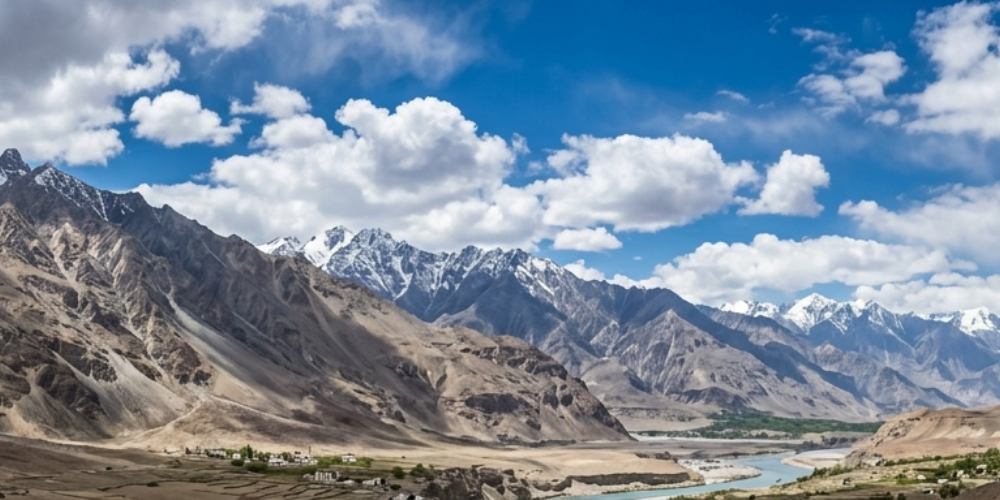
Ladakh
Discover ancient monasteries, Himalayan heritage, and breathtaking landscapes.
Historical Monuments
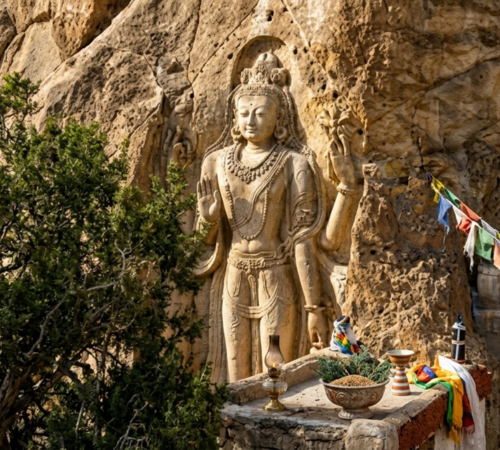
Maitreya Buddha Statue, Mulbekh
Unlike most other stone carvings of Maitreya in the western Himalayas, the Mulbekh sculpture is four-armed. He holds a string of prayer beads and the nagapuspa flower in his ringed upper hands. The nagapuspa flower is a reference to the tree under which Maitreya will eventually sit when, like Buddha Shakyamuni under the bodhi tree, he attains enlightened Buddhahood. In his lower left hand he holds a kundika, a pure-water vase, signifying that in Maitreya’s final life, he will be born into the Brahman caste, not, like Shakyamuni, into the warrior aristocracy. Maitreya’s lower right arm extends in a gesture of giving, reminder of the meaning of his Sanskrit name, which is based on maitri (Tibetan: jampa), meaning “loving kindness.” The stupa nestled against the high chignon on his head unmistakably signals that the carving at Mulbekh is the Future Buddha Maitreya, its shape in a distinctively Kashmiri form.
The stupa has a trapezoidal stepped base, a small dome, and a superstructure with a stack of umbrella-like disks above a platform with slanting struts on top of the dome. This characteristic form goes back at least to Kanishka, the famous Kushana dynasty king and promoter of Buddhism from about the second century CE. Another feature of the Maitreya at Mulbekh in line with earlier Buddhist art is the elaborate arrangement of his hair. Curling “butterfly” loops tied to the ends of his chignon recall double-bow topknots featured in western Kushana dynasty Maitreya images.3
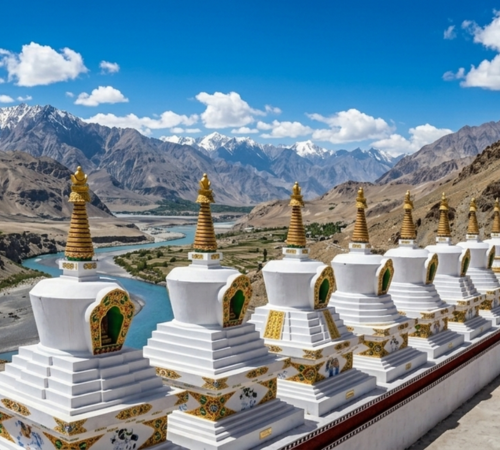
Thiksey Monastery
Thiksey Monastery is the largest monastery in central Ladakh district. It is situated 18 km from Leh in the Indus valley. The Tibetan Buddhist monastery of Gelugpa sect of Tibetan Buddhism is located at the top of hill. The monastery is famous for its architecture and its location. The 12 storey monastery has 10 temples, an assembly hall, and is home to 120 monks and nunnery.
The monastery buildings are structured in hierarchal order. The monastery is referred as ‘Mini Potala’ of India as it resembles Potala Palace in Lhasa, Tibet. There is one big statue of Maitreya (future Buddha) which covers almost two floor of the monastery that is 40 feet in height. Tara temple of Goddess Tara is another major attraction for the visitors. Apart from visiting monastery one can also find some rare and precious stupas, statues, thangkas, wall paintings and swords in the monastery. Due to its proximity to Leh the morning prayer at the monastery attracts huge crowds. The monastery offers clear view of the Indus Valley and some monastery like Shey, Stok and Matho can also be seen from here. Festivals celebration is another major attraction for the tourists, locals and Buddhists in Thiksey Monastery.
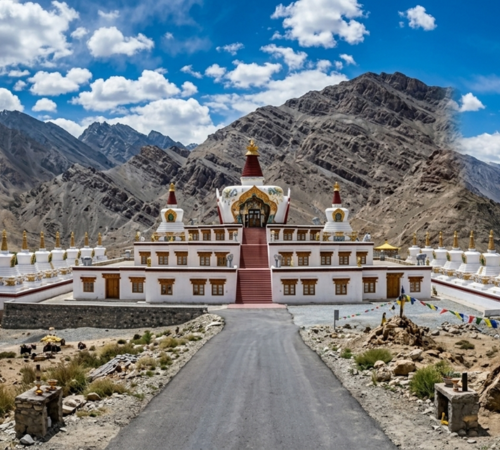
Hemis Gumpha
Hemis Gompa is a world heritage listed Hemis monastery located in the Himalayas. The Hemis Gompa has remained relatively untouched by ravages of modern life due to its high altitude – it is around 12,000 feet above sea level. This makes it one of the highest settlements in use by humans in the world. It predates the 1700’s and many of the buildings are in their original structural form. It is decorated with various murals painted in gold and naturally occurring pigments and compounds that have been manufactured using ingredients found in the immediate vicinity of the Hemis Gompa. The Hemis Gompa hosts an annual festival (known as the Hemis Festival) designed at bringing people in the vicinity of the monastery together and celebrating the birth of Guru Padmasambhava.
The Hemis festival is essentially a Tibetan Buddhist monastery and it is apparent that it takes its cues from Tibetan Buddhist traditions rather than Indian. During the festival monks adorn themselves with brightly coloured clothing and wear their formal monk wear. Men and woman also wear fairly ornate and intricate clothing for the duration of the festival. Families who make their way to the festival usually carry a variety of traditional meals and ingredients localised to the area. It is not unusual to see families hauling pots of yak-butter tea and tsampa. The Hemis festival is celebratory in nature and upbeat.
Celebrations include dancing and traditional brass instruments. Monks perform as devils, evil spirits and re-enact battles that depict good versus evil. The Lamas play an integral role in the celebratory performances and are dressed in finery that compliments the festivals nature. Although many of the dances performed are quite controversial and open to interpretation. The Hemis Gompa is actually decorated quite extravagantly – it is considered to be the richest monastery in Ladakh and its wealth is apparent in the various gold, silver and copper adornments that are on show.
The Hemis Gompa is actually quite a large establishment situated on the banks of the Indus River. It was founded by Stagsang Raspa Nawang Gyatso (first incarnation). The Hemis Gompa is now owned and maintained by a group of Tibetan monks known as the Dugpa Order. The Dugpa Order is responsible for the safeguarding and maintenance of the many valuable relics that are kept at the Hemis Gompa. This is no small task as (stated earlier) the Hemis Gompa is home to a massive wealth of artefacts – some of which predate the Hemis Gompa.
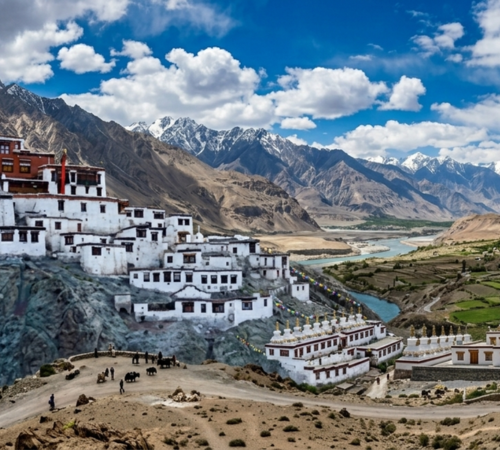
Diksit Monastery, Nubra Valley
Diskit Monastery also known as Diskit Gompa or Diskit Gompa is the oldest and largest Buddhist monastery in the Nubra Valley of Ladakh, northern India.
Diskit monastery is situated in the Nubra valley of Ladakh. Also known as Diskit Gompa, the Buddhist center is one of the oldest and largest monasteries in Leh Ladakh. The Diskit monastery was founded by Changzem Tserab Zangpo in the 14th century, and at present stands atop a hill above the plains of Shayok river. The prime attraction of the Diskit monastery is 100 foot high Maitreya Buddha statue, which was inaugurated by the holy Dalai Lama. From the top of the Gompa, where the divine statue is settled, one can have a panoramic view of the Nubra valley.
The Diskit monastery was founded by Changzem Tserab Zangpo in the 14th century. The history of the Nubra Valley and the monastery could thus be traced from 14th century onwards. Ladakh was then ruled by King Grags -pa-‘bum -lde (1400 -1440) and his brother, who unsuccessfully attempted to usurp Nubra Valley, which was under a local ruler named Nyig – ma – grags -pa. The local ruler assisted a Gelugpa order advocate to build the monastery at Diskit and deify the idol of Tsong Khapa, the founder of the Gelugpa sect, in the monastery.
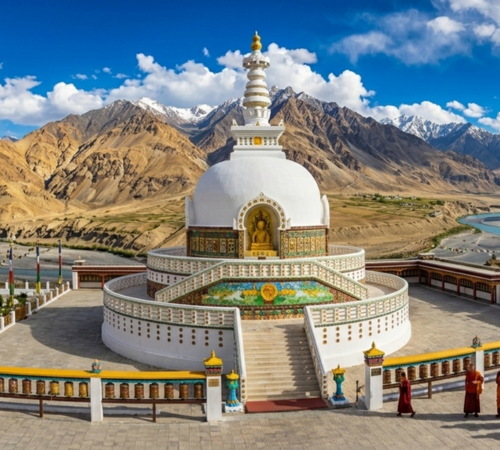
Shanti Stupa, Leh
The stupa is perched atop a small hill in Leh, the capital town of Ladakh. Shanti Stupa offers a stunning panoramic view of the city and the surrounding villages. The stupa was built in 1991 by Japanese Buddhist Bhikshu, Gyomyo Nakamura as a mark of the successful completion of 2500 years of Buddhism and a part of the peace pagoda mission. It holds the relics of the Buddha at its base that were enshrined by the 14th Dalai Lama. The stupa is a two-level structure, on the first, there is a Dharmachakra with deer on each side and a central golden coloured Buddha image sitting on a platform. On the other, there are reliefs depicting the birth and death of Buddha and his defeating devils while meditating. One can witness the devotees circumambulating the stupa in a clockwise direction. Shanti Stupa is a must go for every tourist.
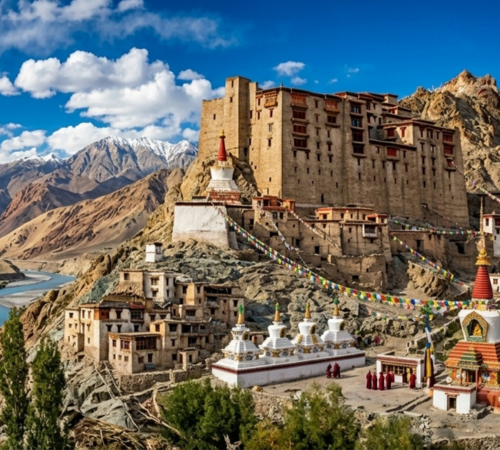
Ancient Palace at Leh
Leh Palace was built during the 17th century by the ruler King Sengge Namgyal. Its construction is on the same lines as the construction of the Potala Palace in Lhasa, Tibet. This palace had to be deserted by the royal family in the middle of the 19th century, because of the taking over of Ladakh by Dogra forces. After this the royal family is living in-exile in the popular Stok Palace. The Archaeological Survey of India (ASI) is restoring some of the ruined portions of this nine-storey palace. While the store rooms were on the lower floors, the royalty resided on the upper floors. The roof of this palace offers an excellent view of the valley.
It served as the regal residence of the Namgyal dynasty until the mid 19th century, after which the royal family permanently shifted to Stok. In present times, the palace is the administrative office of the Archaeological Conservation Organisation that is owned by the Indian Government.
This 9-storey royal edifice is almost in ruins now, but is preserved as a part of Ladakh’s heritage. An example of medieval Tibetan architecture, it has massive walls and wooden balconies. A victory tower, built in the memory of Ladakhi soldiers, is present towards the top of the palace. Ancient mural paintings adorn the interiors of this palace and speak of its golden bygone era.”
JAMMU & KASHMIR
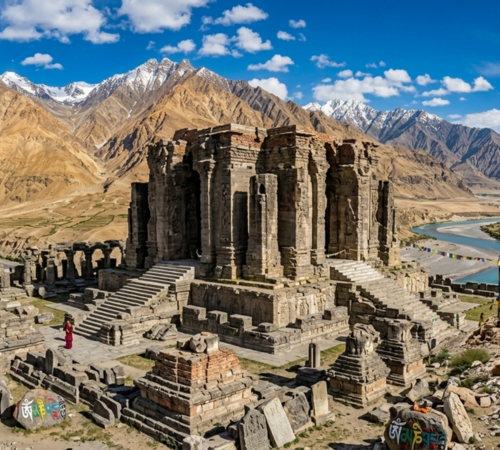
Martand Sun Temple
Martand Sun Temple, a spectacular shrine dedicated to Surya (the Sun), lies at a distance of over five miles from Anantnag in the heavenly state of Jammu and Kashmir, India. This structure is a Kashmiri Hindu Temple and is known as one of the most elegant structures ever built in India. Even in a wrecked state, the temple shares it’s story with the ones who genuinely want to listen. The architecture is breathtaking and the vibe somewhat nostalgic but so enticing that it makes travellers want to come here. A walk across the courtyard is a must for visitors to notice the brilliantly fused designs and carvings on the structure that still stand the tests of time and weather.
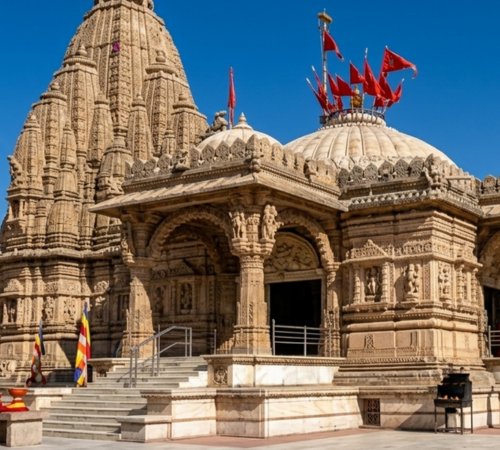
Shankaraya Temple, Srinagar
The Shankaracharya temple is housed in the Srinagar district on the hill known as Takht-e-Suleiman. It is at a height of 1100 ft. above surface level of the main city on the peak of the hill. The Shankaracharya Mandir in Kashmir is dedicated to Lord Shiva and is thought to be the oldest shrine for worship in the Kashmir valley.
The temple as it is today has undergone many repairs throughout its life. Ever since under the rule of Lalitaditya and then repairs were undertaken by Zain-ul-Abideen after the temple got damaged in an earthquake. The repairs were also carried out during the Governorship of Sheikh Mohi-ud-Din. Maharaja Gulab Singh, a Dogra ruler, who is credited for the stone steps that form a part of the passage to the shrine. In 1925, the electrification of the temple was done.