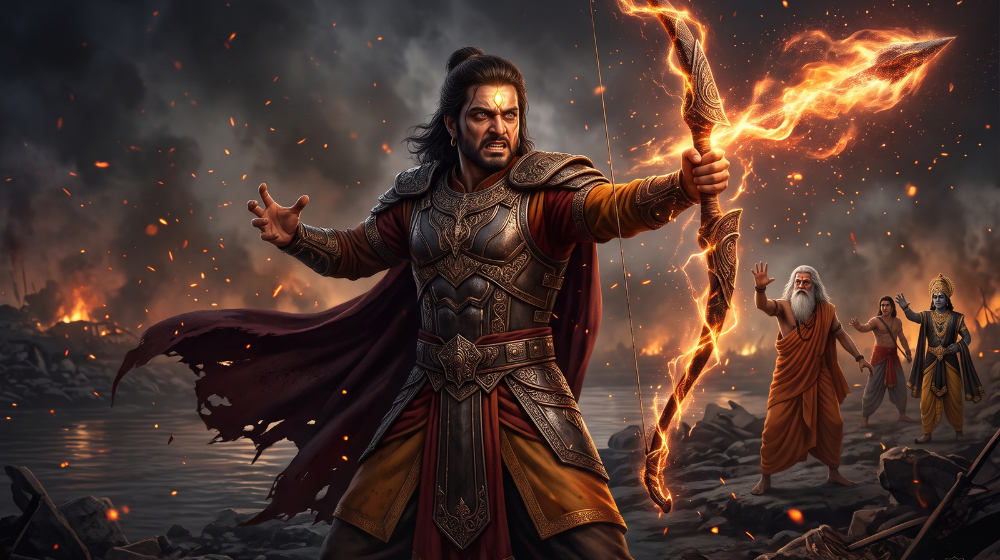
“`html
Ashwatthama: When Power Outruns Judgement
A battle can end before a warrior accepts that it is over. Sometimes, the greatest danger begins precisely at that moment.
By the closing stages of the Kurukshetra war, the Kaurava cause had effectively collapsed. Duryodhana lay mortally wounded, Drona had fallen, and the field that had once carried armies was filled with loss. For Ashwatthama, however, defeat did not bring reflection. It brought a determination to retaliate. His story therefore raises a question that extends far beyond the battlefield: what happens when a person of immense ability allows grief, loyalty and humiliation to overpower judgement?
Yet Ashwatthama’s story did not begin with power. As a child, he grew up in poverty. The Mahabharata recounts how, after seeing wealthier children drink milk, he was once given water mixed with powdered rice and believed that he too had tasted milk. The episode is remembered largely because of what it stirred in Drona, who was pained by his inability to provide for his son. It would be simplistic to draw a straight line from childhood deprivation to Ashwatthama’s later choices, but the contrast is striking. The boy who once lacked even milk would grow into a warrior entrusted with some of the most destructive knowledge of his age.
Ashwatthama was no ordinary warrior. The son of Dronacharya, he received exceptional martial training and grew up alongside princes who would shape the future of the Kuru kingdom. His ability was never the problem. What makes his story especially relevant to leadership is the question of whether ability and readiness are always the same thing. Drona himself appears to have recognised the difference. After giving Arjuna knowledge of the Brahmashira, Ashwatthama pressed his father for the same weapon. Drona eventually taught him, but reluctantly, and warned him never to use it against human beings even in extreme danger. The greater the capability entrusted to an individual, the greater the need for judgement, self-command and ethical discipline.
The greater the capability entrusted to an individual, the greater the need for judgement, self-command and ethical discipline.
Power, Capability and the Responsibility of Authority
The warning is important because authority is rarely given without expectations about how it will be used. In an organisation, access to confidential information, financial discretion, institutional influence or decision-making power is not personal property. It is entrusted for a purpose. Being capable of exercising power does not mean one is prepared to exercise it wisely, and being granted authority does not remove the limits attached to it.
Ashwatthama’s hunger for exceptional power appears again in an extraordinary episode involving Krishna. He sought Krishna’s Sudarshana Chakra and was permitted to try to take it, but could not move it. When Krishna asked why he wanted the weapon, Ashwatthama revealed that he had hoped eventually to challenge Krishna and become invincible. The episode reveals ambition not simply as the desire to excel, but as the desire to possess the symbols and instruments of supremacy. Ambition becomes dangerous when the desire for authority grows faster than the maturity required to exercise it. Leadership cannot be acquired merely by possessing the title, tool or privilege associated with it.
Loyalty, Grief and the Limits of Emotion
His bond with Drona nevertheless remained central to his identity. When Drona was killed after being led to believe that Ashwatthama had died, the loss was devastating. Ashwatthama’s grief was real, as was his fury at the manner of his father’s death. Any reading of his later actions must recognise that emotional wound. Understanding the source of an emotion is not the same as legitimising every action taken under its influence. Pain may explain a decision. It does not automatically justify it.
Pain may explain a decision. It does not automatically justify it.
That distinction matters in organisational life. People carry disappointment, loyalty, pride, memories of unfairness and sometimes the grievances of those they respect. Ashwatthama increasingly allowed loyalty to his father and anger over his death to define the boundaries of what he considered permissible. Responsible loyalty cannot mean surrendering one’s conscience. Leaders must be able to honour mentors, colleagues and institutions without inheriting every grievance as their own moral compass.
When Intelligence Becomes Subordinate to Vengeance
After Duryodhana’s defeat, Ashwatthama, Kripa and Kritavarma withdrew to a forest and rested beneath a banyan tree. Kripa and Kritavarma slept, but Ashwatthama, consumed by rage, remained awake. There he saw an owl descend upon sleeping crows and kill them while they were defenceless. Rather than recoil from the image, he recognised in it a strategy. He resolved to attack the enemy camp at night.
This episode reveals something more disturbing than simple anger. Ashwatthama was still thinking strategically. His intelligence had not disappeared. It had become subordinate to vengeance. Intelligence does not guarantee wisdom, and strategic brilliance does not make the objective itself ethical. Organisations can become highly efficient at pursuing a course of action that should never have been chosen in the first place. Leaders must therefore ask not only, “How can this be done?” but also, “Should this be done at all?”
Even then, Ashwatthama was not without counsel. Kripa urged deliberation and warned against acting under the sway of anger, arguing for restraint and proper judgement. Ashwatthama heard him, but his decision had effectively already been made. The presence of good advisers means little when a leader seeks validation rather than counsel. Healthy leadership requires more than surrounding oneself with experienced people. It requires retaining the capacity to be changed by what they say.
Ethics, Vengeance and the Boundaries of Accountability
Ashwatthama then entered the Pandava camp at night and killed Dhrishtadyumna, Shikhandi, Draupadi’s sons and many others while the camp was largely asleep and unprepared. In that moment, vengeance overcame the boundaries that ought to have governed even conflict. Ethical standards are easiest to defend when they cost little. Their real value appears when anger, competition or perceived injustice creates a convincing reason to abandon them.
Ashwatthama could point to wrongs committed during the war, including the circumstances of his father’s death. But values cannot depend entirely on the conduct of the other side. If every breach authorises another breach, ethics becomes a temporary convenience rather than a governing principle. Responsible leadership interrupts that cycle. It does not require passivity in the face of wrongdoing, but it insists that accountability remain proportionate, principled and directed towards the actual wrong.
His night attack also shows how easily grievance can widen its circle of guilt. His anger arose from particular losses, yet its consequences spread to people who were not responsible for all that he had suffered. Once collective association becomes a substitute for individual responsibility, judgement gives way to punishment by proximity. In institutions, the same failure appears when