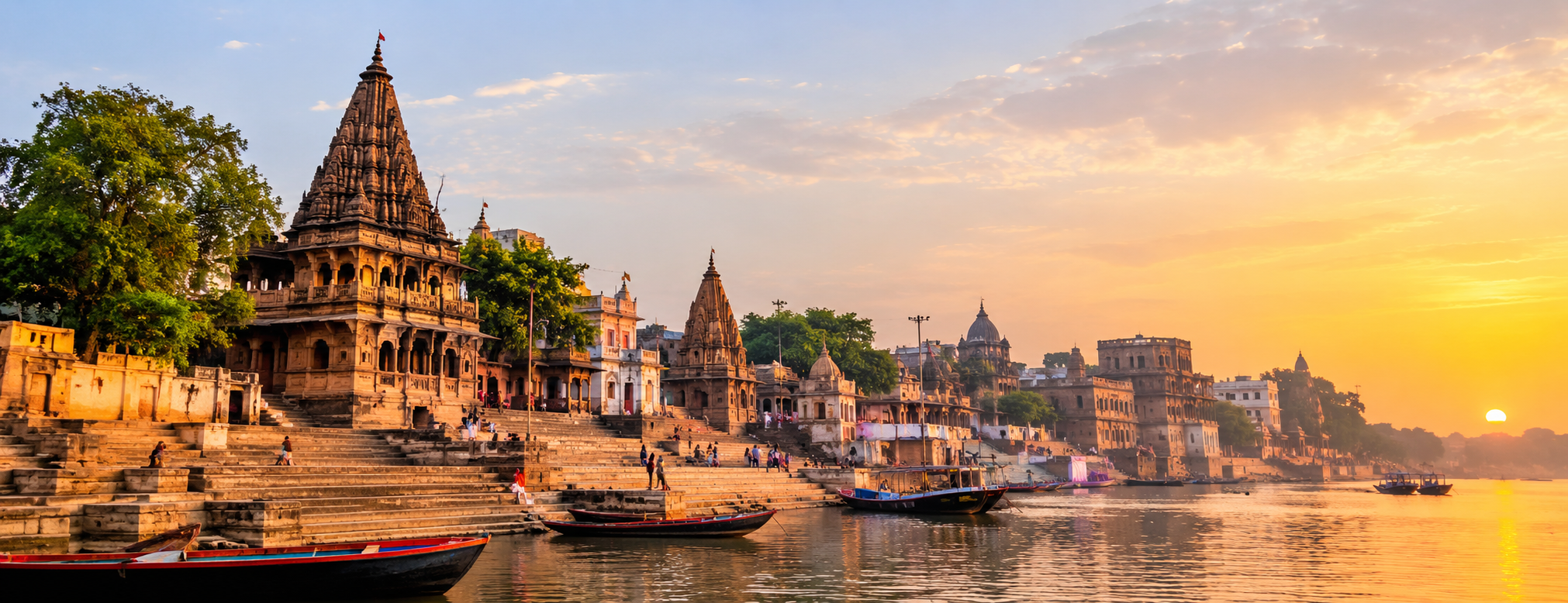
Bihar
Discover ancient universities, sacred temples, historic monuments, GI-tagged crafts, museums and authentic Bihari cuisine.
UNESCO Heritage Sites
Mahabodhi Temple Complex at Bodh Gaya
The Mahabodhi Temple Complex in Bodh Gaya is a UNESCO World Heritage Site and one of the four most sacred places associated with the life of Lord Buddha. It marks the location where he attained enlightenment under the Bodhi Tree in the 6th century BCE. Originally built by Emperor Asoka in the 3rd century BCE, the present brick structure dates back to the 5th–6th century Gupta period. The complex includes the main Mahabodhi Temple, the sacred Bodhi Tree and spots associated with Buddha’s seven weeks of meditation after enlightenment.
The temple, built in the form of a pyramidal structure, stands east of the Bodhi Tree and is notable for its impressive design and historical significance. The gold-painted statue of Buddha made of black stone in the sanctum was built by the Pala kings of Bengal. The Buddha is seen here seated in the Bhumisparsha Mudra or the earth touching posture. Surrounded by stupas, monasteries and meditation gardens, the complex offers a peaceful spiritual atmosphere and remains a major global Buddhist pilgrimage centre, attracting monks, scholars and travellers from around the world.
Archaeological Site of Nalanda Mahavihara
This UNESCO World Heritage Site stands as one of the finest symbols of India’s ancient academic and spiritual heritage. Founded in the 5th century CE, Nalanda flourished for nearly 700 years as one of the world’s earliest and most prestigious residential universities. It attracted thousands of scholars, monks and students from across Asia, making it a major centre of learning, intellectual exchange and Buddhist thought. A wide range of subjects, including Buddhist scriptures of both the Mahayana and Hinayana traditions, philosophy, theology, metaphysics, logic, grammar, astronomy and medicine were taught here. The fame of the university spread far beyond India and detailed accounts by Chinese travellers, Hiuen-Tsang and I-Tsing provide valuable insights into its academic life, structure and significance.
Although Nalanda began to decline during the late Pala period, its final destruction came with invasions around 1200 CE. Today, its ruins remain a major attraction for historians, archaeologists, Buddhist pilgrims and travellers interested in India’s cultural legacy. The site features an impressive layout of monasteries, stupas, shrines, lecture halls and residential quarters, revealing the advanced planning and architectural excellence of the period. Ongoing excavations continue to uncover new insights into this remarkable centre of learning.
Museums
Archaeological Museum, Nalanda
Established in 1917, the Nalanda Museum is one of the most prestigious site museums of the Archaeological Survey of India (ASI). It showcases antiquities excavated from the Nalanda Mahavihara, one of the world’s earliest and most renowned residential universities and monastic complexes dating around 5th-12th centuries CE, along with select artifacts from Rajgir.
The museum houses over 13,000 antiquities, with around 350 artifacts displayed across four galleries and the main hall, including stone sculptures, bronze images, terracotta and stucco artifacts, inscriptions, coins, pottery, copper plates, ivory and bone objects, along with rare samples of burnt rice from the 12th century CE. Highlights include magnificent sculptures of Buddha, Bodhisattva Avalokiteshvara, Maitreya, Samantabhadra, Trailokyavijaya, Parshvanath and Nagaraj, among others. A detailed scale model of the excavated Nalanda University complex in the main hall offers visitors an overview of this remarkable UNESCO World Heritage Site.
Archaeological Museum, Vaishali
The Vaishali Museum, established by the ASI in 1971 was created to preserve and display antiquities discovered during the excavation of sites associated with ancient Vaishali. Designed with four galleries arranged around a central courtyard, the museum houses 2002 antiquities, of which 569 are on display. The collection spans a long historical period from 600 BCE to 1200 CE and provides valuable insights into the Maurya, Sunga, Kushan, Gupta and early medieval cultures.
Reflecting the region’s deep roots in both Buddhist and Jain traditions, the museum features depictions of Jain Tirthankaras alongside a notable Pala-period sculpture of Buddha. The museum also features a remarkable headless sculpture of Buddha in Bhumisparsha mudra, along with Hindu sculptures of Vishnu and Uma Shankar. Other displays include figures of humans and animals such as monkeys, snakes, horses and bulls as well as coins, pottery, terracotta figurines.
Archaeological Museum, Bodh Gaya
This Archaeological Museum, located in the Bodhgaya village of Bihar’s Gaya district, was inaugurated by His Holiness the Dalai Lama on 27 December 1956. Facing north, the museum building features an elegant façade decorated with ornamental arches and terracotta jaali work. It consists of three galleries along with a portico, verandah and corridor, where artifacts are displayed for visitors. The museum houses a rich collection of priceless antiquities, including remnants of stone railings dating from the 1st–2nd century BCE and the 7th century CE, as well as sculptures from the Pala period (8th–12th century CE). Its collection also includes terracotta, stone and metal objects that reflect the region’s artistic and religious heritage.
Among the most remarkable exhibits are beautiful images of Buddha, Maitreya, Manjusri, Avalokitesvara, Tara and Jambhala, along with standing images of Vishnu, Ganesha, Uma-Maheshwara, Kamadeva and the Saptamatrikas. One of the museum’s most significant pieces is a colossal stone image of the Buddha standing in abhaya mudra with important events from his life carved on the back.
Archaeological Museum, Vikramshila
Vikramshila Museum is one of the significant site museums located at Antichak in Bihar. The museum is closely associated with the remains of the ancient Vikramshila Mahavihara, one of the most renowned centres of Buddhist learning during the Pala period. Vikramshila University was founded by the Pala king Dharmapala in the late 8th or early 9th century CE. It is especially significant for the study of the stylistic and iconographical development of Buddhist sculptures. The art here reflects transitions from Mahayana to more ornate Vajrayana styles.
Many sculptures, roughly dated from the 8th to the 12th centuries CE have been excavated and are now preserved in the museum. The museum houses a remarkable collection of Buddhist sculptures made in different materials and media, a wide range of antiquities, including stone beads, terracotta discs, seals, objects made of glass and terracotta, household earthen utensils of various shapes, coins, inscriptions, antimony rods and other excavated objects. Together, these collections provide a valuable insight into the artistic, cultural and everyday life of the Vikramshila period.
Historical Monuments
Barabar & Nagarjuni Caves
Located in the Jehanabad district, the Barabar (four) and Nagarjuni (three) caves represent the earliest surviving examples of rock-cut architecture in India, datable to the Mauryan period (3rd century BCE). The Barabar caves were dedicated by Emperor Ashoka and the Nagarjuni caves by his grandson Dasharatha to the ascetics of Ajivika sect. Carved out of monolithic granite blocks, these caves are globally renowned for their precision-engineered, mirror-like “Mauryan polish” on the interior walls, also known to create an echo/reverberation effect inside the chambers.
The Lomas Rishi cave within the Barabar caves features an iconic ogee-shaped chaitya arch entry adorned with an elephant frieze, which heavily influenced later Buddhist architecture. Because granite is incredibly difficult to cut without modern explosives, the creation of all these geometrical chambers using only iron chisels, hammers and wooden wedges is considered a marvel of ancient engineering. They served as the structural prototype for all subsequent rock-cut architecture across the Indian subcontinent for the next thousand years.
Ashoka’s Pillar (Lauriya Nandangarh) and Hall (Kumrahar)
Located in the West Champaran district of Bihar, the Asoka Column at Lauriya Nandangarh is one of the finest preserved monumental pillars erected by Emperor Ashoka in the 3rd century BCE. Carved from a single block of polished buff-coloured Chunar sandstone, the monolithic pillar stands over 10 metres high and is crowned by a bell-shaped capital with a frieze of flying geese (hamsa) supporting a finely sculpted seated Asiatic lion. It bears six of Ashoka’s major pillar edicts inscribed in Brahmi script. The surrounding ancient burial (stupa) mounds, dating to the Vedic and Mauryan periods further enhance the site’s archaeological and historical significance.
Kumrahar in Patna is the archaeological site of ancient Pataliputra, the Mauryan imperial capital. It preserves the remains of the celebrated Assembly Hall of 80 monolithic Chunar sandstone pillars, dating to the 3rd century BCE, each originally about 10 metres high and finished with the distinctive Mauryan polish. The hall is widely associated with Ashokarama, where Emperor Ashoka is believed to have convened the Third Buddhist Council around 250 BCE.
Ancient Ruins of Rajgriha
According to ASI, Rajgir (ancient Rajgriha) served as the formidable first capital of the Magadha Empire. The site is split into two distinct areas: Old Rajgriha, an extensive valley naturally fortified and encircled by five imposing hills and New Rajgriha, fortified by a massive mud rampart built outside the valley.
The most defining architectural marvel here is the pre-Mauryan Cyclopean Wall, an astonishing 40-kilometer-long fortification assembled using massive, undressed interlocking stones. Rajgriha holds paramount spiritual significance; it was a favoured retreat of Gautama Buddha, who delivered critical sermons at Gridhrakuta (Vulture’s Peak) and is deeply revered by Jains as a prominent domain of Tirthankara Mahavira. Extensive archaeological excavations have unearthed vital remnants of ancient stupas, defensive walls, water reservoirs and monasteries that showcase early Indian urban engineering.
Rohtasgarh Fort
Perched strategically on a high sandstone plateau about 1,500 feet above the sea level near the Son River, Rohtasgarh Fort is officially recognized as one of the largest and most formidable military strongholds in the world. Spanning across a vast 42 square kilometres, the fort complex features 83 monumental gateways, an intricate network of underground tunnels and defensive ramparts averaging 15 feet in thickness.
While its legendary origins connect it to Prince Rohitashva, the existing monumental framework stands as an exemplary specimen of Indo-Islamic military architecture built primarily by the Afghan Emperor Sher Shah Suri in 1543 to secure vital regional trade routes. Later, during the Mughal era, Raja Man Singh served as governor and heavily expanded the fort, constructing the magnificent four-storied palace Takht-e-Badshahi, the intricate Aina Mahal (Mirror Palace) and highly decorated assembly halls supported by beautifully carved pillars.
Tomb of Sher Shah Suri
Administered as a monument of national importance by the ASI, this grand mausoleum in Sasaram is an architectural masterpiece of Indo-Islamic design. Built between 1540 and 1545 entirely out of fine red sandstone, the 122-foot-high structure was planned during the lifetime of Emperor Sher Shah Suri and completed under his successor, Islam Shah.
Designed by architect Aliwal Khan, the three-storied octagonal tomb stands grandly on a massive square stone plinth situated in the exact centre of a vast, 22-acre artificial lake. Connected to the mainland by an elegant stone causeway, its corners are adorned with beautiful domed kiosks (chhatris). The primary tomb chamber is surmounted by an expansive dome spanning 22 meters, which was originally embellished with vibrant, coloured glazed tile work, earning it historical recognition from archaeologists as a crowning achievement of Pathan engineering.
Relic Stupas at Vaishali
The Relic Stupa at Vaishali is recognized by the ASI as one of the earliest archaeologically attested stupas in human history, dating to the 5th century BCE. Following the Mahaparinirvana of Gautama Buddha, the democratic Licchavi clan received one-eighth of his corporeal remains, enshrining them in a primitive mud-and-clay stupa. Excavations (1958–1962) revealed that the original 26-foot-diameter structure was expanded with brick during the Mauryan, Shunga and Kushana eras. Its core yielded a sacred soapstone casket containing holy ashy earth, a gold leaf fragment, glass beads, a conch shell and a punch-marked copper coin.
This legacy connects directly to the monumental Kesariya Stupa. Tradition holds that when the Buddha left Vaishali for Kushinagar, the devoted Licchavis refused to leave him. To persuade them to return, the Buddha gifted them his sacred alms bowl. The Licchavis built a stupa at Kesariya to enshrine this relic. Much like the Vaishali stupa, Kesariya underwent successive historical expansions, eventually growing into a soaring, terraced brick structure that stands today as one of the tallest Buddhist stupas in the world.
Takht Sri Patna Sahib
Revered by the National Portal of India and Bihar Tourism as the second holiest of the five Takhts (seats of temporal authority) in Sikhism, this sacred shrine marks the birthplace of Sri Guru Gobind Singh Ji Maharaj, the tenth Sikh Guru, who was born here in December 1666. Consecrated by the physical visits of three Sikh Gurus—Guru Nanak Dev, Guru Tegh Bahadur and Guru Gobind Singh—the grand, white-marble structure reflecting majestic Sikh architecture was originally commissioned in the early 19th century by Maharaja Ranjit Singh. After suffering damage in the 1934 earthquake, the modern-day complex was meticulously rebuilt. The holy site features distinct golden domes and houses a specialized repository displaying invaluable historical relics, including original handwritten Hukumnamas (divine decrees), a sacred sword, a gilded cradle and ivory sandals belonging to the Gurus.
GI Tagged Handicrafts
Madhubani Painting
Madhubani Painting, also known as Mithila Art, is a celebrated folk-art tradition from the Mithila region of Bihar. Traditionally created by women on freshly plastered mud walls and floors, this vibrant art form is known for its bold line drawings, bright earthy colours, intricate patterns and completely filled spaces. The paintings are made using natural dyes and mineral pigments derived from local sources — black from soot, yellow from turmeric, blue from indigo, red from kusum flower juice or red sandalwood, green from leaves, white from rice powder and orange from palash flowers. Artists use fingers, twigs, bamboo sticks, brushes, nib-pens and matchsticks to create the designs.
Madhubani paintings commonly depict themes from nature, mythology and daily life. Popular subjects include Hindu deities, along with the Sun, Moon, Tulasi plant, wedding scenes, court scenes, floral motifs, animals, birds and geometric patterns. These designs are passed down through generations, preserving the traditional identity of the art. Over time, Madhubani painting has moved beyond mud walls to paper, cloth and canvas, making it accessible to wider audiences and global markets. Supported by the Government of India, this art form has become an important source of non-agricultural livelihood for thousands of artisan families in Bihar.
Applique (Khatwa) Work
Khatwa is a traditional appliqué craft from Bihar, historically used to decorate tents, canopies, wall hangings and household furnishings. The art involves cutting motifs from coloured fabric and stitching them onto a base cloth with fine hemming, creating designs and narratives entirely through fabric. In contemporary workshops, linen is often used as the base, with a palette of earthy and pastel tones. Khatwa draws inspiration from nature as well as everyday domestic life. Common motifs include trees, flowers, birds, animals, utensils and scenes from rural life. Artisans often enhance the appliqué with delicate embroidery and thread work to create textured, layered compositions.
The craft continues in both personal and commercial forms, where men often cut patterns and women stitch them together. Over time, Khatwa has evolved from a domestic storytelling tradition into a recognised textile art form, helping women artisans from regions such as Patna and Sitamarhi gain wider visibility through exhibitions and markets in India and abroad.
Sujani Embroidery Work
Sujani is a traditional embroidery craft from Bihar, particularly associated with Bhusura village in the Muzaffarpur district of Mithila region. Historically, it was used to make soft quilts and wraps for newborns by stitching together layers of old saris and dhotis. Over time, Sujani evolved from a domestic craft into a distinctive textile art form that also includes wall hangings, bedcovers, curtains and other home furnishings.
The craft is known for its fine running stitch, often compared to kantha, which is used to fill motifs and create textured surfaces. Artisans begin by selecting a base fabric and tracing designs onto it before embroidering them with running, chain and hemming stitches. Traditionally inspired by nature, fertility symbols, sacred motifs and scenes from everyday life, contemporary Sujani also reflects social concerns such as women’s rights, child marriage and dowry. Each piece combines storytelling, skill and cultural memory, making Sujani one of Bihar’s most distinctive textile traditions.
Sikki Grass Products
Sikki is an ancient grass craft traditionally practised by women in the Mithila region of North Bihar. The craft uses sikki grass, which grows in wet and marshy land and is harvested during the monsoon, then dried and cut for weaving. With remarkable skill and precision, artisans transform this simple natural material into both utilitarian and decorative objects such as baskets, bags, hats, coasters, dauda, mauni, chataayi and even paintings. Known for its fine craftsmanship and intricate patterns, Sikki reflects the creativity of Mithila’s women artisans and remains an important part of Bihar’s craft heritage.
Bhagalpur Silk
Known as the “Queen of Fabrics,” Bhagalpur Silk is celebrated for its fine texture, natural elegance and enduring quality. Originating from Bhagalpur in Bihar, known as the Silk City of India, this fabric reflects a rich legacy of craftsmanship, culture and tradition. Often associated with Tussar Silk, it is admired for its natural lustre, strength, breathable texture and refined finish. Its history dates back to the Vedic Age with its prominence continuing through the Mauryan period and beyond. Over centuries, Bhagalpur developed into a renowned centre for sericulture and weaving, earning national and international recognition for its exceptional silk craftsmanship.
The making of Bhagalpur Silk is a meticulous process that combines traditional handloom weaving techniques with careful finishing. From boiling cocoons and spinning the yarn to dyeing, weaving, washing and pressing, every step contributes to the fabric’s distinctive texture, sheen and character. This thoughtful process often supported by sustainable practices makes Bhagalpur Silk a symbol of enduring luxury. Today, it is widely used in premium apparel, saris, scarves, stoles and home décor products valued for its versatility, elegance and artisanal appeal.
Bawan Buti Sari
Deeply rooted in Bihar’s ancient textile heritage, Bawan Buti is a masterful handloom craft defined by its name, Bawan (52) and Buti (motifs). Originating as the pioneer of cotton-on-cotton brocade, this meticulous art form involves weaving exactly 52 identical, intricate symbols into the fabric using a labour-intensive extra-weft technique.
The craft captures the beauty of the universe, drawing deep inspiration from the Buddhist iconography of nearby Nalanda. Symmetrical cultural symbols like the Bodhi tree, stupas, peepal leaves and the wheel of dharma are painstakingly brought to life on the loom. Preserved for generations by weaving families in and around the historic village of Baswan Bigha, Bawan Buti remains an outstanding symbol of timeless craftsmanship and artistic devotion.
Patharkatti Stone Craft
Patharkatti stone craft from Bihar’s Gaya district is known for its finely carved Buddhist, Jain and Hindu sculptures. The craft’s lineage dates back nearly 300 years to when Maharani Ahilyabai Holkar of Indore brought skilled Gaud Brahmin artisans from Rajasthan to rebuild Gaya’s sacred Vishnupad Temple. Crafted from locally sourced black granite, artisans create idols of Lord Buddha, Goddess Mahagauri, Hindu deities and folk figures with exceptional skill and precision. Today, this stone carving continues to stand as a symbol of Bihar’s craftsmanship, tradition and cultural pride.
Pidiya Painting
Bhojpur’s Pidiya Painting is a traditional folk art created mainly by women on the mud walls of village homes during festivals and social occasions. It is deeply associated with rituals like Govardhan Puja and the sacred bond between brothers and sisters. After plastering the walls with mud and cow dung, they use natural colours to paint motifs such as flowers, trees, birds, the sun, moon, elephants, sacred pots and symbols of deities. Made using fingers, palms or small wooden pieces, the art reflects rural life, family bonds, religious beliefs, nature and local traditions.
Temples
Vishnupad Temple
Vishnupad Temple, located in Gaya on the banks of the Phalgu River is one of Bihar’s most important and ancient pilgrimage sites. The present temple was rebuilt in 1787 by Queen Ahilyabai Holkar of Indore. Surrounded by rocky hills on three sides and the river on the fourth, the temple is associated with the Ramayana, Mahabharata and the life of Gautama Buddha.
Dedicated to Lord Vishnu, the temple is famous for the sacred footprint of Vishnu, known as Dharmasila, engraved in a block of basalt rock. According to Hindu belief, Lord Vishnu subdued Gayasur by placing his foot on his chest leaving this footprint behind. The temple is also a major centre for Pind Daan, the ritual performed for the salvation of ancestors. It is believed that Lord Rama performed the rites for his father King Dasharatha here. Hindus worship the footprint as that of Lord Vishnu, while some Buddhists worship it as the footprint of Lord Buddha.
Mundeshwari Devi Temple
Located atop the Mundeshwari Hills (Paura Hill) in the Kaimur district of Bihar, the Mundeshwari Devi Temple is one of the world’s oldest functioning Hindu temples, where worship has been performed uninterrupted for centuries. The temple is dedicated to Goddess Mundeshwari (a form of Durga/Shakti) and Lord Shiva, along with the deities Ganesha, Surya and Vishnu. The ASI dates this temple to 108 AD and has protected it as a national monument since 1915. It is regarded as one of the earliest surviving examples of Nagara-style temple architecture. Built from stone in a rare octagonal plan, the structure is adorned with exquisite Gupta-period carvings and inscriptions that provide valuable insights into ancient Hindu rituals and traditions.
Originally associated with Viniteswara (Shiva), the temple became an important centre for Shakti worship around the 7th century AD when the Cheros, indigenous rulers of the Kaimur Hills made Goddess Mundeshwari their principal deity. Today, a Chaturmukha (four-faced) Shiva Lingam continues to occupy the central sanctum, while the idol of Goddess Mundeshwari is enshrined in the eastern niche. A majestic stone Nandi also stands at the western entrance. The temple is famous for its unique tradition of bloodless animal sacrifice in which a goat is ritually offered without being harmed, attracting thousands of devotees during Maha Shivaratri and Rama Navami.
Badi Patan Devi Temple
Located in the heart of Patna, Badi Patan Devi Temple is one of the revered Shakti Peethas and a major pilgrimage site dedicated to Goddess Durga. The temple lies southeast of the famous Takht Sri Harmandir Sahib, the birthplace of Guru Gobind Singh. According to mythology, the right thigh and sacred cloth (pata) of Goddess Sati fell at this site in ancient Magadha, an area now identified with the Maharajganj and Chowk neighbourhoods of Patna. The temple is unique for enshrining the three principal manifestations of the Divine Mother, Mahakali, Mahalakshmi and Mahasaraswati, as black stone idols in a standing posture, adorned with traditional saris and crowns. Alongside the goddesses sits Vyom Bhairav, a manifestation of Lord Shiva. Badi Patan Devi attracts thousands of devotees throughout the year, particularly during the festival of Navratri.
Deo Sun Temple
Located about 10 km southeast of Aurangabad in Bihar, the ancient Deo Surya Temple is one of India’s most revered temples dedicated to the Sun God. Believed to have been originally built by Pururava, son of Ila and later restored in the 15th century by King Bhairavendra Singh of the Chandravanshi dynasty of Umga, the temple is a striking 100-foot-tall structure showcasing early North Indian temple architecture.
The temple is an important centre of Sun worship where devotees offer prayers at sunrise and sunset and take a holy dip in the sacred Brahma Kund. It is especially renowned for its grand Chhath Puja celebrations, when thousands of pilgrims from across the country gather to worship Lord Surya. Widely regarded as the birthplace of the Chhath tradition, the temple remains one of Bihar’s most significant spiritual and cultural landmarks offering visitors a unique blend of history, faith and architectural beauty.
Jal Mandir
Nestled amidst the serene waters of Pawapuri in Bihar, Jal Mandir is one of the holiest pilgrimage sites of Jainism. The temple marks the sacred spot where Lord Mahavira, the 24th Tirthankara, attained Moksha (Nirvana) and was cremated around 527–528 BCE. Built of pristine white marble at the centre of a tranquil lotus-filled lake, it derives its name Jal Mandir (Water Temple) from its unique location.
According to tradition, the immense demand for the ashes from Lord Mahavira’s funeral pyre led to the removal of so much soil that a large water tank was formed, upon which the temple was later constructed. It is believed to have been built by King Nandivardhan, Lord Mahavira’s elder brother. Jal Mandir draws devotees, spiritual seekers and history enthusiasts from across the world, offering an atmosphere of profound serenity and devotion.
Cuisine
Litti Chokha
Considered the culinary identity of Bihar, Litti consists of whole wheat flour balls filled with a spiced mixture of sattu (flour of dry-roasted Bengal gram), carom seeds (ajwain), mustard oil and lemon juice. It is traditionally roasted over a cow-dung or coal fire and dipped in pure ghee. It is paired with Chokha, a rustic accompaniment made of boiled or fire-roasted potatoes, eggplants and tomatoes mashed together with raw mustard oil, green chilies and coriander.
Sattu Parantha & Sharbat
Sattu, the ancient, nutrient-dense superfood of Bihar is also used to make parantha as well as sharbat. Sattu parantha is a protein-rich breakfast flatbread where the dough is stuffed with a savoury, tangy sattu mixture (infused with garlic, chilies, mustard oil and local pickles) and cooked on a griddle. The sattu sharbat is an instant, cooling energy drink prepared by mixing sattu with cold water, roasted cumin powder, black salt, lemon juice and occasionally mint and finely chopped onions.
Champaran Meat
Originating from the Champaran region, this globally recognized dish relies on slow cooking. Mutton is marinated with onions, ginger-garlic paste, a signature blend of whole and ground spices and raw mustard oil. It is then sealed inside a clay pot (handi or ahuna) using wheat dough and cooked gently over charcoal. The clay uniformly distributes heat, trapping the moisture and aromas to create highly tender meat with a rich, smoky gravy.
Thekua
Thekua is a crisp sweet that holds massive cultural significance as the primary prasad (holy offering) during Bihar’s Chhath Puja festival. It is prepared by kneading wheat flour, dry fruits and ghee into a tight dough using molten jaggery (gur) or sugar. The dough is pressed onto beautifully carved wooden moulds to imprint traditional patterns before being deep-fried in ghee until golden brown.
Dahi Chuda
This is a classic, comforting staple across Bihar, particularly popular in the Mithila region and traditionally consumed during the Makar Sankranti festival. It is a completely fireless dish assembled by washing flattened rice (chuda or poha), layering it with fresh, thick curd (dahi) and sweetening it with jaggery or sugar. Dahi Chuda is highly valued as a gut-friendly, easily digestible morning meal.
Dal Bhaat Bhujiya
The ultimate everyday comfort meal in almost every Bihari household, Dal Bhaat Bhujiya represents simplicity and balance: Bhaat (steamed rice) and Dal (soupy, seasoned lentils, usually tur or masoor) served with Bhujiya. Here, Bhujiya specifically refers to finely sliced vegetables (most commonly potatoes or Aloo) stir-fried dry with basic spices like turmeric, cumin and green chilies until perfectly crisp.
Maach Bhaat
This is a defining culinary staple of the Mithila region of North Bihar, where freshwater rivers make fish a vital part of the diet. Local freshwater varieties like Rahu or Katla are shallow fried in mustard oil and then simmered in a distinct, pungent gravy driven by yellow mustard paste, garlic and spices. It is traditionally eaten with steamed rice (bhaat).
Makhana Kheer
Bihar accounts for over 85–90% of India’s total Foxnut (Makhana) production, concentrated heavily in the Mithila zone. Makhana Kheer is a rich regional dessert prepared by roasting the foxnuts in ghee, crushing them slightly and simmering them in milk reduced to a thick consistency. It is sweetened with sugar and flavoured generously with cardamom, saffron and chopped nuts.
Silao Khaja
A highly celebrated regional dessert that holds a registered GI Tag from the Government of India, Silao Khaja hails from the town of Silao in Nalanda district. This crispy, light-yellow sweet consists of 12 to 16 ultra-thin, delicate layers of dough made from wheat flour, ghee, cardamom and aniseeds (saunf). It is deep-fried to a perfect crunch and lightly coated in sugar syrup.