Chhattisgarh
Discover ancient forts, sacred temples, GI-tagged crafts, and authentic regional cuisine.
Historical Monuments
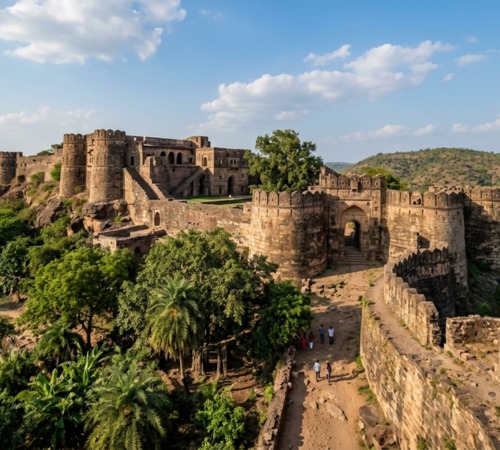
Malhar Fort
The ancient fortified settlement of Malhar in Bilaspur district represents architectural and cultural developments associated with the Somavanshi and Kalachuri dynasties, dating back over a thousand years. Excavations have revealed a wide range of artefacts, including pottery, terracotta figurines, iron tools, weapons, and rice grains. Evidence of continuous habitation from the pre-Mauryan, Shunga-Satavahana, Gupta-Vakataka, and post-Gupta periods has been found in the citadel area. The discovery of well-planned structures, including stone and brick steps and drainage systems, highlights the advanced technology and organized social life of the time.
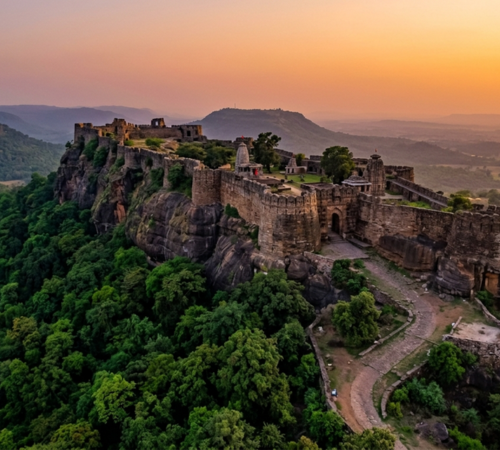
Chaiturgarh Fort
Chaiturgarh (Lafagarh) fort is situated on a hilltop in the Korba district of Chhattisgarh. Constructed by Raja Prithvidev I around the 11th century CE, it is surrounded by formidable natural walls along with high artificial walls built at specific points. This natural fort features three main entrance gates – Menaka, Humkara, and Simhadwar. The hilltop houses about five ponds, Shankar’s Cave, and the famous Mahishasura Mardini Temple, among others. The sanctum sanctorum of this temple enshrines a splendid 12-armed idol of the Goddess Mahishasura Mardini, a form of Durga.
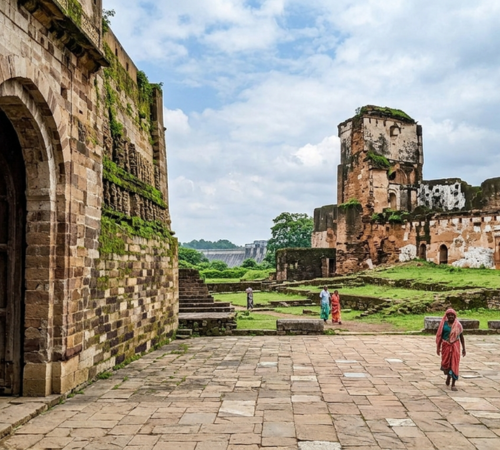
Ratanpur Fort
The ancient fort at Ratanpur, also known as Hathi Kila, dates back to around the 11th–12th century CE and is believed to have been established during the reign of the Kalachuri king Ratnadeva I. Within the fort premises, remains from later periods are visible including a palace complex, a bathhouse-like structure and some sculptures on the fort walls. The fort features intricately carved stone sculptures, including depictions of mythological figures such as Ravana and Hanuman. With multiple gateways and adjacent historic temples, the fort is a testament to the region’s rich history and cultural significance.
Sitabengra & Jogimara Caves
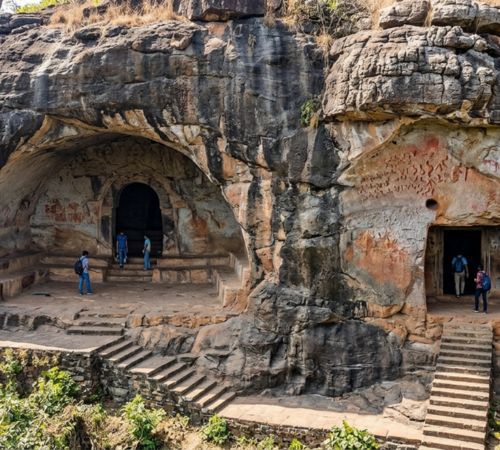
Ramgarh’s rocky terrain located in the Sarguja district of Chhattisgarh is home to several caves, such as the Sitabengra and Jogimara, that date back to around 3rd century BCE. Sitabengra Cave, locally known as a Natyashala, is considered one of the earliest examples of an Indian theatre, traditionally associated with Kalidasa. It has an oblong plan with a flattened front roof, rock-cut seating arranged in crescent-shaped terraces, and a 3rd century BCE Brahmi inscription on its eastern wall. Jogimara Cave is smaller, north-east facing, and has a curved ceiling. It contains early paintings and a Brahmi inscription (3rd–2nd century BCE), often interpreted as a love message between Sutanuka, a devadasi, and Devadinna, a sculptor—possibly one of the earliest references to the term devadasi. The artwork depicts processions, dancers, floral and geometric patterns, fish, and animals.
Buddha Vihar
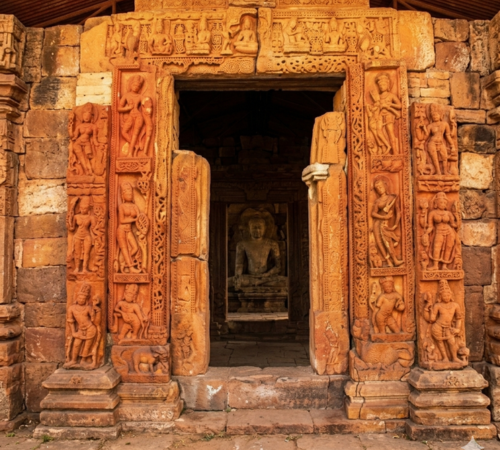
Buddha Vihar (Anandprabhu Kutir) is a significant archaeological site located in Sirpur village, Chhattisgarh. The 7th-century Chinese traveller Hiuen Tsang also mentioned Sirpur in his accounts. The complex features two adjoining courtyards and a monastery (vihara) housing a Buddha image, flanked by figures such as Padmapani. The remains offer insight into the lives of resident monks and their teaching practices, reflecting Sirpur’s rich Buddhist heritage. It is believed to have been constructed during the reign of the Somavanshi king Tivara Deva and continued in use until the time of his grandson Mahashivagupta Balarjuna in the 7th–8th century CE. The entrance carvings depict various aspects of life, including relationships such as love, matrimony, and friendship, along with scenes inspired by Buddhist themes.
Temples
Pataleshwar Mahadev Temple (Malhar)
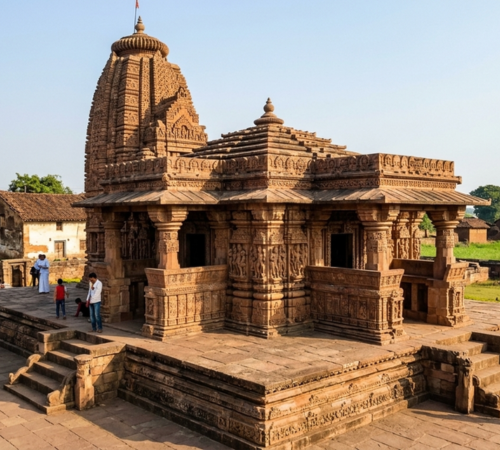
The Pataleshwar Mahadev Temple located in the ancient town of Malhar within the Bilaspur district of Chhattisgarh, dates mainly to the Kalachuri period (around the 12th century CE). It was built by a Brahmin named Somraj during the reign of Kalachuri ruler Jajalladeva II. The temple is dedicated to Lord Shiva with Nandi placed before the shrine, and features beautifully carved stone pillars. The Shiva Lingam is located below ground level, and according to local belief the water offered during worship flows into the underground (patal), giving the temple its name Pataleshwar.
Rajiva Lochana Temple (Rajim)
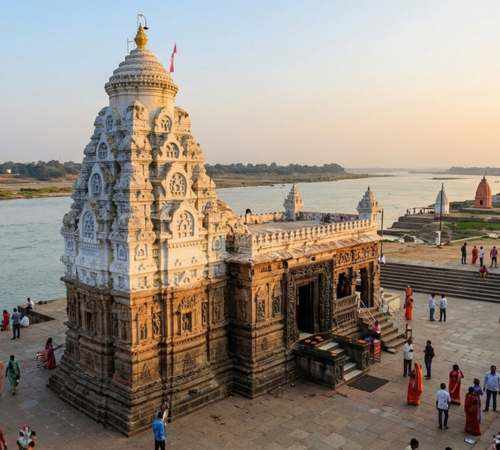
Situated at the confluence of the Mahanadi, Pairi and Sondhur rivers, Rajim, the “Prayag of Chhattisgarh” is renowned for the famous Rajiv Lochan Temple in the Gariaband district. Believed to have been constructed around 7th to 8th century CE, the temple is an important example of early temple architecture in the Dakshin Kosala region. Its structural layout features a sanctum (garbhagriha) and a grand pillared mandapa. The presiding deity is a four-armed (chaturbhuja) Vishnu depicted with his traditional divine attributes. Nearby this temple, archaeological excavations carried out in recent years at Sitabari have revealed remains dating back to the Mauryan period also.
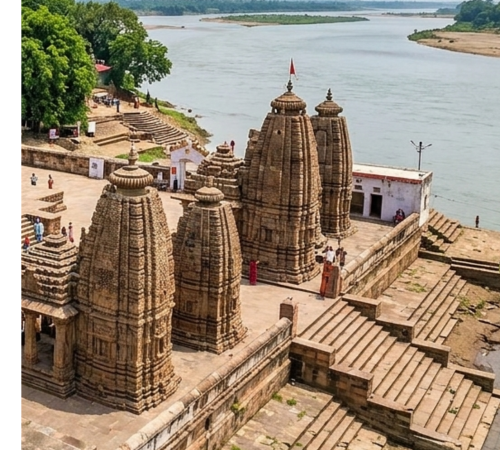
Shivrinarayan Temple Complex
The Shivrinarayan Temple Complex is a historic 11th-century Vaishnavite site located in the Janjgir–Champa district of Chhattisgarh, on the banks of the Mahanadi River at Shivrinarayan Nagar. It was built by the kings of the Haihaya (Kalachuri) dynasty and is associated with Shabari’s Ashram from the Ramayana, according to Hindu mythology. While many temples in the complex are dedicated to Lord Vishnu, it also includes the 12th-century Chandrachud Mahadev Temple dedicated to Lord Shiva. The temples are adorned with intricate carvings and inscriptions of historical significance. A grand fair is also organized here on the occasion of Magh Purnima.
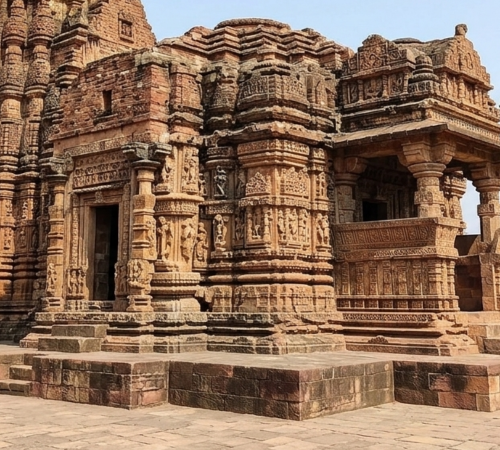
Bhand Dewal Temple
The Bhand Dewal at Arang in Raipur district is a beautiful Jain Temple belonging to the early Kalachuri period from around 11th century CE. Built upon a raised platform, it has a stellate sanctum preserving the polished black basalt images of three Tirthankaras, Ajitanatha, Neminatha and Shreyansanatha, standing in the kayotsarga or standing meditative posture. The temple rises to a height of about 25 metres and displays all the six principal components of temple architecture. Its external walls are richly carved with sculptural representations containing divine images of Jaina Tirthankaras, yakshas, yakshis, as well as dancers, musicians, among others.
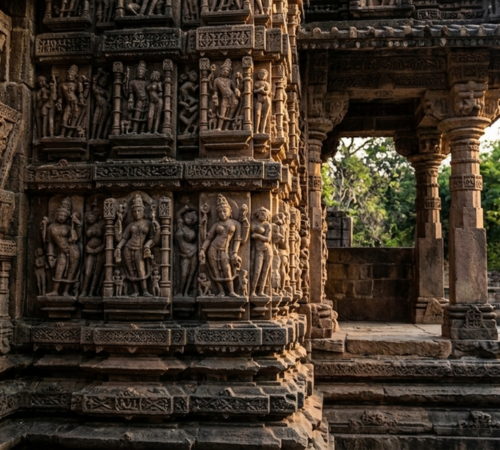
Bhoramdeo Temple
Bhoramdeo Temple is a notable example of the Nagara-style architecture dedicated to Lord Shiva, carved in stone. Located in the Kabirdham district of Chhattisgarh, it dates back to around 7th–11th century CE, built by King Ramchandra of the Nagavanshi dynasty. The architectural features with erotic sculptures make it similar to the Khajuraho Temple in Madhya Pradesh and the Konarak Sun Temple in Odisha. Within 2km from Bhoramdeo, the Madwa Mahal (meaning marriage hall in local dialect) commemorates the marriage of the King Ramachandra and Princess Ambika Devi in 1349 AD. It also consists of a unique Shiva Linga erected over 16 pillars.
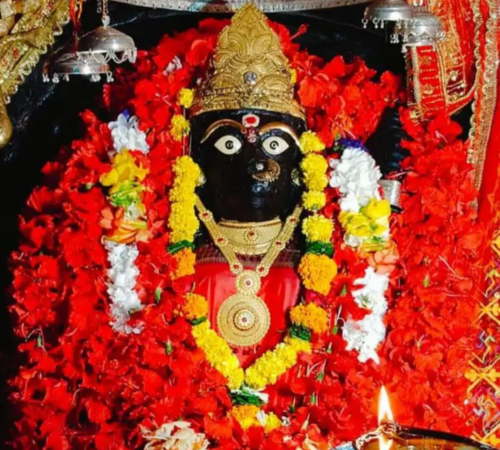
Danteshwari Temple
The Danteshwari Temple was established by the Kakatiya rulers of Bastar to honour Goddess Danteshwari, their family deity. It is one of the revered Shakti Peethas, located at the confluence of the Dakini and Shankini rivers in Dantewada, and is generally dated to the 14th century CE. According to Hindu mythology, the temple marks the site where the tooth (dant) of Goddess Sati is believed to have fallen. The façade is built in a wooden hut style and an ancient stone Garud pillar stands opposite to the temple entrance. Inside the sanctum sanctorum, the idol of Goddess Danteshwari made of black stone resides, guarded by idols of two celestial beings at the door. The inner walls are also adorned with detailed carvings. The temple becomes lively during the Bastar Dussehra festival.
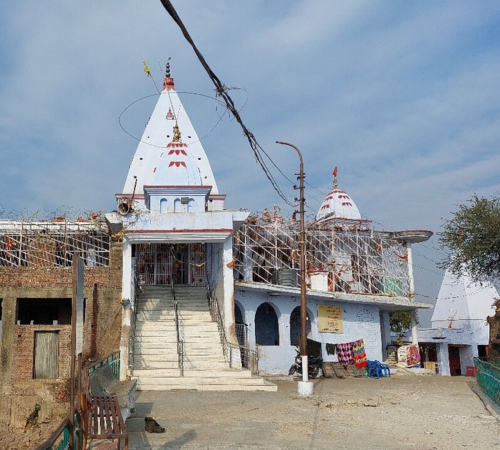
Mahamaya Temple
Located on the eastern hills of Ambikapur, the Mahamaya Temple Ambikapur is dedicated to Goddess Mahamaya (Ambika Devi) and is believed to have been built under the patronage of the Kalachuri rulers of Ratanpur around the 12th century CE. The temple features a unique dual idol, with the front depicting Mahishasura Mardini (Durga) and the rear representing Goddess Saraswati. It attracts large numbers of devotees during Chaitra and Sharad Navaratri. Built in the Nagara style, the temple is supported by sixteen stone pillars and is associated with a large water tank. The temple complex, which once included ancillary structures such as smaller shrines and royal buildings, reflects the historical legacy of the Ratanpur kingdom. Within the complex stands the Kanthi Dewal Temple, likely constructed in the 11th century and later expanded during the Kalachuri period, possibly under Prithvideva II. It houses a polished black basalt Shivalinga and features architectural elements such as a jharokha (bay window) and decorative niches.
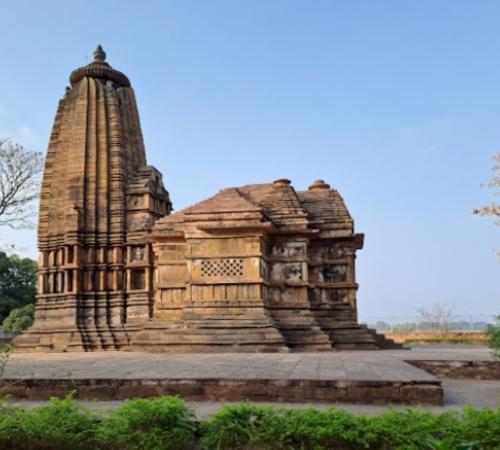
Narayanpal Temple
The Narayanpal Temple is situated on the northwestern side of Jagdalpur, nearby the Chitrakote Falls. This Vishnu Temple was constructed by Queen Gunda Mahadevi from the Chindak Nagavanshi dynasty around 11th-12th century CE. It has a garbhagriha, antarala and mandapa, with a saptaratha plan. The curvilinear shikhara over garbhagriha is surmounted by an amalaka and a kalash. Located near the Indravathi River, this temple is one of the very few in the entire Bastar district that contains a statue of Lord Vishnu. It also bears influences of the Chalukya style of architecture.
GI Tagged Handicrafts
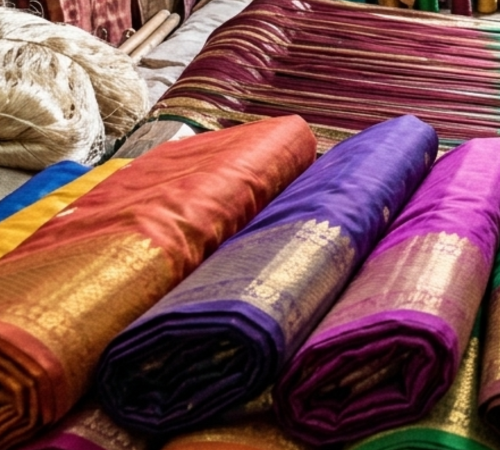
Champa Silk Saree and Fabrics
Champa Silk Sarees and fabrics are crafted from wild tussar silk (Antheraea mylitta) and are known for their distinctive rough texture. This Champa or Kosa silk is derived from cocoons reared on Arjun, Saja, and Sal trees. The patterns are created using contrasting extra weft yarns on jacquard looms, with designs inspired by tribal motifs. Vibrant embroidery, along with natural and dyed hues and imaginative patterns, enhances the beauty of each piece. The contrast between the golden shade of the base fabric and the bright natural dyes used for designs and patterns sets it apart from other types of silk sarees. Apart from sarees, dress materials, stoles, dupattas, and home furnishings also showcase the elegance of Kosa tussar culture.
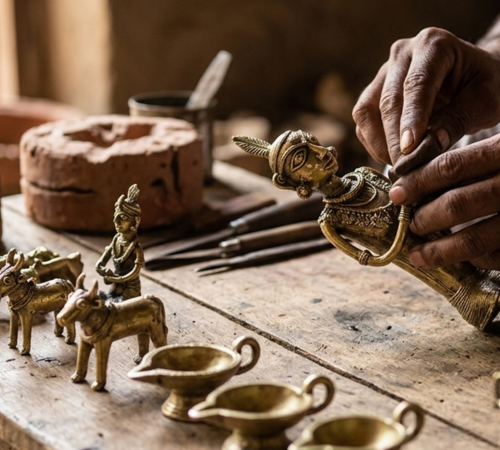
Bastar Dhokra
The bell metal craft, also known as Dhokra art, dates back over 4,600 years to the ancient Indus Valley Civilization. This craft is practiced by the Ghadawa community of Bastar using the traditional lost-wax (vanishing wax) technique. Skilled artisans use a unique combination of metals such as brass, tin, and iron to create intricate and ornate objects, including figurines of deities, animals, pots, and lamps, often rich in tribal symbolism and religious motifs. A variety of raw materials, such as clay, coal, rice husk, paraffin wax or beeswax, nut oil, tree resin, and scrap metal, are used in this process.
Cuisine
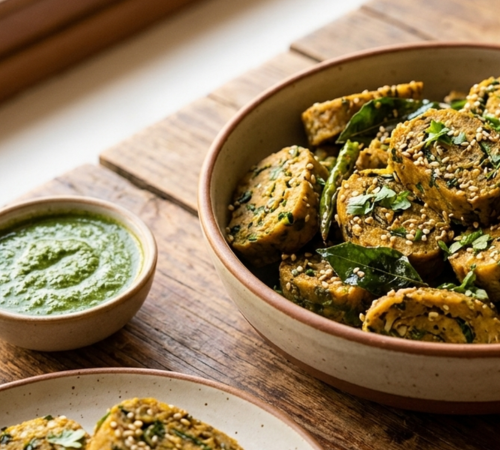
Muthia
Muthia is a traditional delicacy from Chhattisgarh, made from rice flour combined with sesame seeds, garlic, fresh coriander leaves, and aromatic spices. The name Muthia is derived from the Hindi word muthhi (fist), as the dough is shaped by pressing it in a fist to form small dumplings. This dish is especially popular during the winter season, and is typically prepared by steaming rather than frying making it a healthier option. It is widely enjoyed as a breakfast dish by both urban and rural communities in Chhattisgarh.
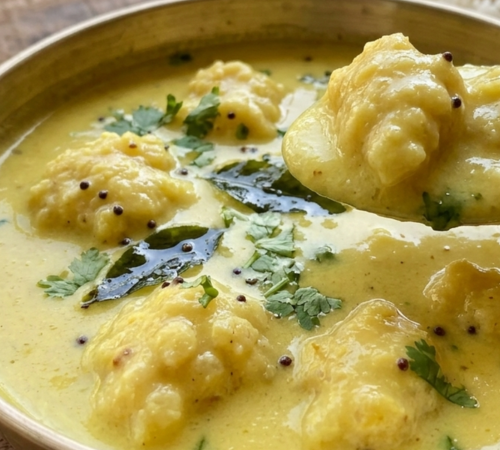
Dubki Kadhi
Kadhi is a tangy and spicy curry popular across several Indian states. In Chhattisgarh, Dubaki Kadhi is a well-known variation in which small balls/pakodas made from urad dal paste are added to a boiling kadhi prepared with buttermilk or curd and besan (gram flour). Apart from Dubaki Kadhi, there are several other popular varieties in the state, including Bhindi (okra) Kadhi, Kochai or Aravi (colocasia/taro root) Kadhi, and Lauki (bottle gourd) Kadhi. This dish is typically enjoyed during lunchtime.
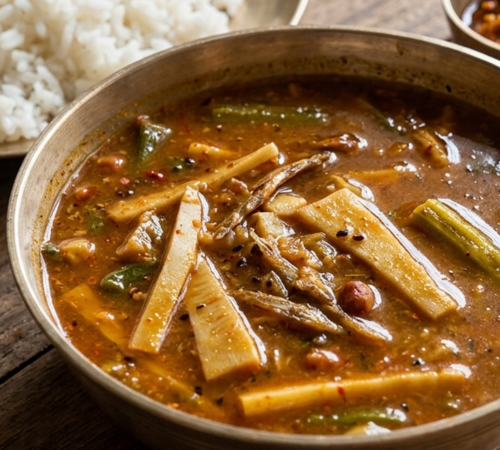
Aamat
, similar to Sambar (a lentil-based curry), is prepared using mixed vegetables, ginger-garlic paste, and a variety of spices such as asafoetida and cumin. This sour and spicy dish is very popular in the Bastar district of Chhattisgarh and traditionally includes bamboo shoots as a key ingredient. It is often prepared on special occasions and is typically served with cooked rice or roti/chapati.
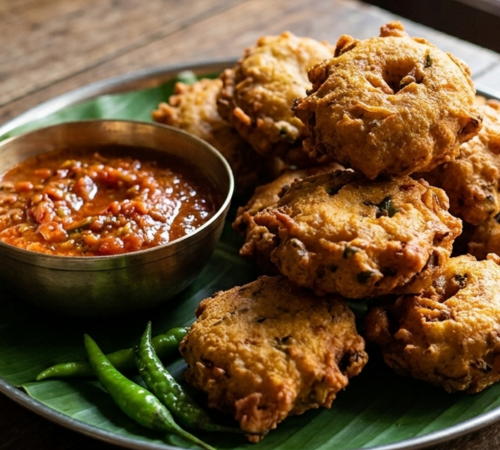
Bhajia
Bhajia is a popular snack prepared by coating vegetables in a batter made of gram flour and spices, and then deep-frying them in hot oil. Variants such as Mirchi Bhaji (chili), Pyaaz Bhaji (onion), and Aloo Bhaji (potato) each offer a distinct flavor. These crispy fritters, also known as pakoda, are often enjoyed with a cup of hot tea and spicy green chutney on the side.
Bafauri
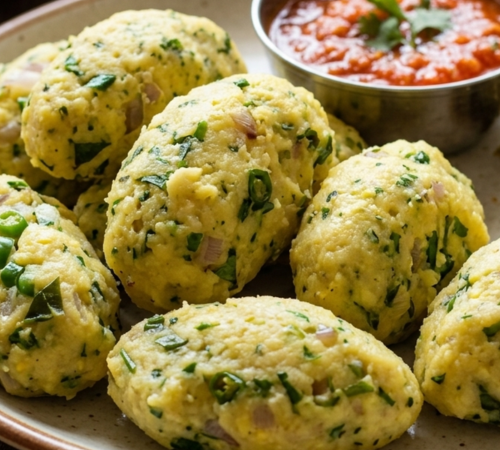
Bafauri is a traditional dish prepared using a batter of chana dal (split chickpeas) mixed with various vegetables. Spices such as chopped green chilli, ginger, onion, coriander leaves, garlic paste, and turmeric powder are added to enhance its flavour. The mixture is shaped into small balls and steamed for 15 to 20 minutes, making it a healthier alternative to Bhajia as it avoids the use of oil in its preparation.
Sabudana Khichdi
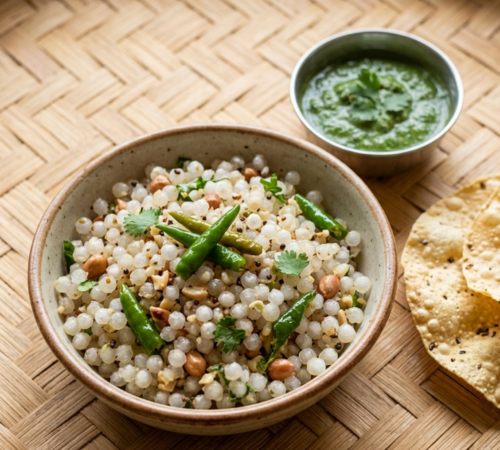
Sabudana Khichdi is a light yet flavourful dish made from soaked sabudana (tapioca pearls), gently cooked with vegetables, aromatic spices, and herbs to create a delightful balance of taste and texture. Widely enjoyed during fasting periods, this wholesome preparation has also become an integral part of everyday cuisine in Raipur and across Chhattisgarh, appreciated for its simplicity, nutrition, and comforting appeal.
Chila
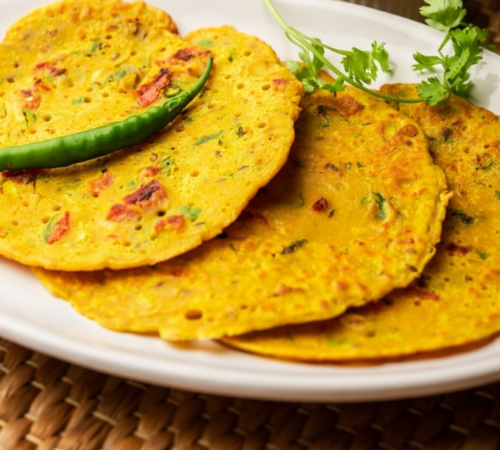
Chila is a thin, savory pancake typically prepared from a mixture of rice batter and urad dal, and is often served with spicy chutney. A popular breakfast staple, it can also be made using moong dal (green gram), urad dal (black gram), or besan (Bengal gram flour). Often referred to as the Chhattisgarhi version of Dosa, Chila differs in that it is prepared without fermentation, making it quicker and easier to cook.
Faraa
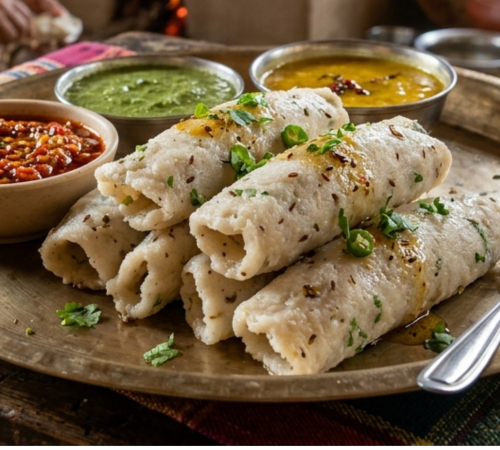
Faraa is a traditional Chhattisgarh dish made from rice dough lightly seasoned with coriander and minimal spices. The dough is prepared using rice flour, warm water, and a pinch of salt, and can be stuffed with spiced black gram or green gram paste. These dumplings are steamed to create a light and healthy snack, though they can also be lightly fried with mustard seeds, cumin, sesame seeds, ginger, garlic, and green chilli for a spicier, crispier variation.
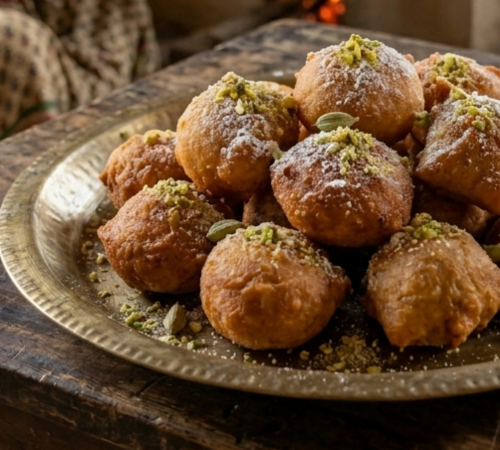
Khurma
Khurma is a beloved Chhattisgarhi dessert similar to Sewaiya. Prepared with roasted vermicelli simmered in milk, it is sweetened with sugar or jaggery and enriched with a generous mix of premium dry fruits. Creamy, aromatic, and indulgent, Khurma is a delightful treat often enjoyed during festive occasions and special gatherings.
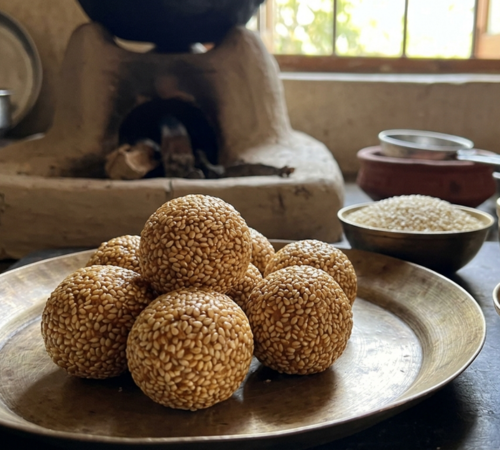
Tilgur
Tilgur is a traditional laddoo made by combining roasted sesame seeds with dark jaggery and peanuts. This wholesome sweet holds a special place during festivals, especially Makar Sankranti, when it is traditionally prepared and enjoyed as a symbol of warmth and togetherness.