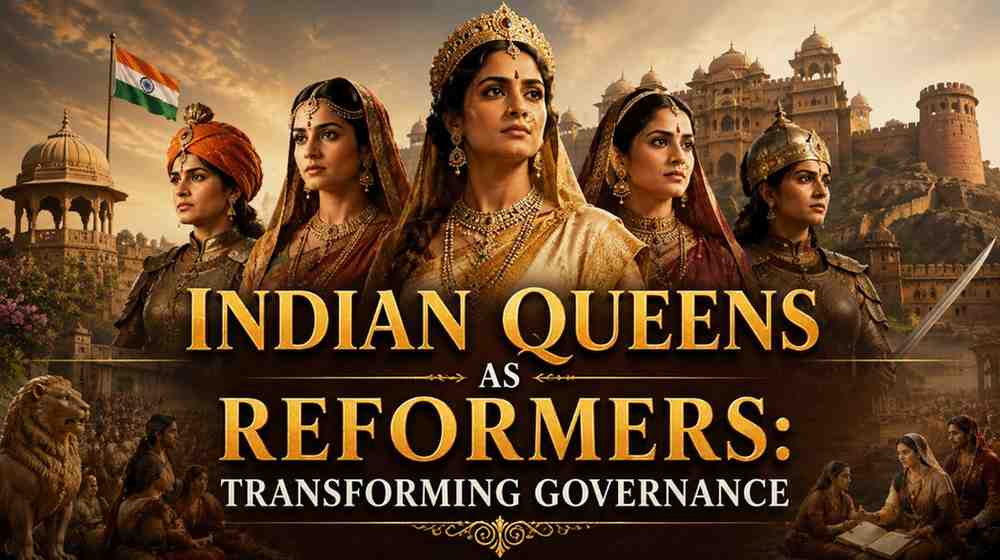
Indian Queens as Reformers: Transforming Governance
Epigraphical and historical evidence suggests that women in ancient and medieval India were not merely passive figures in royal courts but active participants in public life and governance. Several queens and empresses introduced far-reaching reforms characterized by accessible justice, social welfare and pioneering public works. Beyond governance, many were also skilled military leaders who personally commanded armies and defended their kingdoms in times of crisis.
Their contributions challenged contemporary gender norms and left a lasting imprint on the society. This article explores some of India’s remarkable queens whose visionary leadership shaped governance and offers timeless lessons till date.
Effective leadership is rooted not in gender or lineage, but in justice, public welfare, inclusion and accountability.
Administrative and Land Reforms
Razia Sultana (13th century) challenged entrenched aristocratic privilege by appointing officials based on merit rather than lineage. Her elevation of Jamal-ud-Din Yakut, an Abyssinian of slave origin, to a senior position broke the monopoly of the Turkish nobility over high office. She also held open courts where ordinary citizens could directly present grievances and acted firmly against corrupt officials, making governance more accountable and accessible.
Rani Durgavati (16th century) simplified land revenue administration, strengthened village-level governance and fostered trust between the state and cultivators. Her administration respected tribal customs while integrating tribal leaders into governance, enabling effective administration across a culturally diverse kingdom.
Jijabai (17th century), though never formally assigned an official title, successfully administered the war-ravaged Pune Jagir. She promoted equitable land distribution, fair taxation and meticulous record-keeping while strengthening village panchayats as institutions of local accountability and community-based dispute resolution. Her administrative abilities stabilised Pune economically and socially, providing the foundation upon which Shivaji later built the Maratha state.
Ahilyabai Holkar (18th century) regarded good governance as a balance between material prosperity and moral responsibility. Her administration was characterised by transparency, merit-based appointments and accessible justice. She also held regular public darbars where citizens could directly present grievances irrespective of their social status. She regulated land revenue to prevent exploitation, reduced unnecessary taxation and provided relief during droughts, setting enduring standards for accountable and people-centric governance.
Rani Chennamma (18th-19th century), celebrated for resisting the East India Company’s annexation of Kittur, also strengthened local self-governance through village panchayats, promoted agricultural development and ensured fair judicial processes, particularly in cases involving land disputes and caste-based injustice. She also curbed exploitation by local zamindars and intermediaries. Her leadership inspired freedom fighters like Sangolli Rayanna, who carried forward her struggle against British rule.
Collectively, these governance models anticipated modern principles of accessible justice, citizen participation and a responsive administration.
Social Reforms
Ahilyabai Holkar emerged as one of India’s earliest advocates of women’s welfare. She discouraged forced Sati, protected widows from social coercion, encouraged widow remarriage and supported their rehabilitation through land grants, vocational training, loans and employment. She promoted female education, recognised women’s property rights and appointed qualified women to administrative positions.
Her patronage of the Maheshwari handloom industry generated sustainable livelihoods while preserving cultural heritage. She also worked for the welfare of marginalised communities, including the Bhils and Gonds, through education, land rights and economic opportunities. Further, she extended her charitable works to people of all faiths.
Rani Mangammal (17th–18th century) asserted a woman’s right to leadership by refusing to commit Sati after her husband’s death and instead assuming the responsibilities of governance. An inclusive approach to governance was reflected through her support for temples, mosques, dargahs and cordial relations with religious missionaries.
Rani Durgavati’s respect for tribal traditions and Jijabai’s encouragement of participatory village institutions further strengthened social cohesion by ensuring that governance remained responsive to local communities.
Together, their administrations fostered coexistence and mutual respect, offering enduring lessons on social cohesion in diverse societies.
Strategic and Infrastructural Reforms
Rani Durgavati reorganised Gondwana’s military into an efficient force of cavalry, infantry and archers, many trained under her personal supervision. She shifted her capital from Singorgarh to Chauragarh to improve strategic defence and administrative oversight. Her investments in canals and water reservoirs enhanced agricultural productivity and reduced dependence on erratic monsoons.
Razia Sultana strengthened urban administration through improved market regulation and city security, reinforcing both economic activity and public order.
Rani Mangammal built and repaired roads across her kingdom, planted avenue trees for travellers and established public rest houses and food inns, including the renowned Mangammal Chathiram in Madurai. The historic highway linking Tirunelveli and Kanyakumari, the Rani Mangammal Salai, reflected her lasting contribution to connectivity.
She also strengthened agriculture by repairing irrigation networks, notably the Uyyakkondan Canal near Tiruchirappalli and constructing major irrigation canals and tanks across the Cauvery river basin. Her legacy endures in iconic landmarks such as the Tamukkam Palace in Madurai and the Palace Darbar Hall in Tiruchirappalli.
Ahilyabai Holkar combined economic development with public welfare by investing extensively in roads, bridges, wells, reservoirs, ghats, hospitals, public baths and rest houses. She strengthened agriculture through irrigation, promoted secure trade routes and regulated marketplaces.
During periods of famine and distress, she supported free kitchens, food storage systems and charitable institutions that provided relief to vulnerable communities. A patron of culture, she restored numerous temples, forts and public monuments, including the Maheshwar Fort complex, while supporting scholars, poets, artisans and musicians.
Her large-scale plantation of shade-giving and medicinal trees reflected an early commitment to environmental stewardship.
These initiatives remain relevant in an era marked by climate change, water scarcity and food security concerns. Consequently, the governance reforms introduced by these queens present highly relevant blueprints for modern and future challenges.
Conclusion
Women’s history is indispensable and essential to the emancipation of women. Across regions and centuries, these remarkable queens demonstrated that effective leadership is rooted not in gender or lineage, but in justice, public welfare, inclusion and accountability.
From Razia Sultana and Rani Durgavati to Jijabai, Rani Mangammal, Rani Chennamma and Ahilyabai Holkar, each left a legacy of people-centric governance that addressed the everyday needs of citizens while overcoming formidable social and political barriers.
Their contributions reveal that many ideals associated with modern governance – transparent administration, social inclusion, grassroots participation, women’s leadership and environmental resilience have historical roots in India.
In a political landscape still struggling with female representation, these rulers serve as prototypes for the future. They redefined what good leadership means, a legacy that can meaningfully inform modern governance reforms.
The historical precedent they set powerfully validates India’s legislative commitment to the 33% reservation of seats for women in the Lok Sabha and State Legislative Assemblies.
Fully realizing this democratic transition and closing the gender gap in public as well as private leadership injects fresh perspectives that drive innovation, directly contributing to more robust, equitable and inclusive macroeconomic growth.